
Cardzia review: is this TCG card estimation app worth it?
Cardzia, the French card estimation app for Pokemon, One Piece and Lorcana: what it does well, its limits, its price, and how it stacks up against other collection apps.
Looking for a Cardzia review before you install it? The French card estimation app has made a lot of noise in a short time, and the question we get asked most often is simple: does it deliver on its promises, and is it enough to manage a collection long term? Here is our take, factual and sourced from information published by the developer, followed by what PokéItem does differently.
This article was last updated on 18 August 2026. The apps mentioned release updates every few weeks: check their store listings before making a decision.
What exactly is Cardzia?
Cardzia is a trading card collection management and estimation app, developed by a French team. On their "About us" page, the story is clear: the company was founded in 2023 in Marseille and Aix-en-Provence by four co-founders, built around one very concrete idea - knowing the value of your cards without spending hours on it. The app itself launched in December 2025.
That distinction matters when reading comparisons: Cardzia is a young company with three years of history, but a recent app. And traction came fast - they claim 80,000 users in the six months following launch, and more than 3 million cards in their database.
Their stated ambition goes beyond an estimation tool: "We are building the first TCG ecosystem in Europe." On their own site, the roadmap mentions adding buying and selling. That is worth knowing, because it shows where the product stands today and where it wants to go.
What Cardzia does
The scan is fast, and that is the core of the product
Cardzia advertises a full estimate in under three seconds, and unlimited scanning is available for free. At PokéItem, scanning succeeds on more than 98% of cards, measured across more than 150,000 scans, and also identifies rarity and language.
Estimates come from French sales
Cardzia calculates its estimates from real completed sales on the French market, not an international average. The price shown corresponds to French transactions. The trade-off is that a single source allows no cross-referencing: PokéItem combines Cardmarket, completed eBay sales and its own index, and displays a confidence level for each price.
The logical consequence of that choice is depth: a price built on a national market rests on fewer transactions than one built across the entire European market. For a card that rarely changes hands, the reference is mechanically weaker, with no other source to correct it.
Multi-TCG support
Cardzia is not limited to Pokemon: it also covers One Piece Card Game and Disney Lorcana. That is currently its most visible difference in scope compared to Pokemon-focused apps.
It is also a gap that is closing. The PokéItem pricing and recognition engine already powers OpItem, the One Piece app from the same publisher, and is available to developers under the name TCG API. One Piece and Lorcana integration into PokéItem is on the roadmap: the multi-TCG infrastructure exists and runs in production, it just needs to be exposed inside a single app. That is the shift being targeted - one reference app across all TCGs, with the same pricing depth already in place for Pokemon.
Sealed product and graded cards are supported
Boxes, booster displays, ETBs and other sealed products can be added to your collection, and an update added support for graded cards. PokéItem covers both as well, and goes further on valuation: cards are estimated condition by condition, from Near Mint to Poor, whereas Cardzia stops at three tiers.
Pre-filled listings
Cardzia generates pre-filled sale listings to post on Vinted or Leboncoin. That does not make it a marketplace - the transaction happens elsewhere - but it prepares the text for you to copy across. At PokéItem, the listing stays inside the app: it is published on the Marketplace, positioned against the market price, and shown first to collectors who are missing that exact card. No commission, and no leaving the app.
Four limits worth knowing
These are the gaps that matter most day to day, once the novelty of the first scan wears off.
Three condition tiers. Cardzia grades cards across three tiers: New, Good, Poor. PokéItem values each copy from Near Mint to Poor. If you track a high-value collection where the gap between Near Mint and Excellent runs into tens of euros, you will miss the finer granularity.
No web version. The app exists on iOS and Android. There is no browser access: entering a large collection by keyboard on a big screen is not possible.
Buying and selling are not yet integrated. Cardzia prepares a listing text to copy onto Vinted or Leboncoin, where buyers are not specifically searching for your card. PokéItem publishes the listing in its Marketplace, against the market price, in front of collectors who are missing that card. Their roadmap announces buying and selling, so this point may change - which is exactly why this comparison is dated.
Interface in French. That is consistent with a product anchored in the French market, but worth noting if you collect in English or Japanese.
The scanner, point by point
Scanning is the most-used action in any collection app, so it deserves the most detail. Three concrete differences, as announced by the publishers:
- Success rate. PokéItem's recognition succeeds on more than 98% of scans, measured across more than 150,000 scans as of 18 August 2026, in under three seconds with a good connection. The target set for 2027 is to exceed 99% success in under one second. None of the three other apps publish a measured success rate.
- What the scan identifies. PokéItem recognises the card, its rarity and its language: scan a German or Japanese card and it drops it into the right binder. None of the three other apps announce card language identification.
- Volume. PokéItem Premium members can scan an entire binder page in one shot (beta), instead of card by card. That is the only page-level scan in this comparison.
- Free trial. On PokéItem, the scanner can be tested without creating an account, and scans are doubled for the first month after sign-up.
And behind the scan, valuation does not stop at a single number: the recognised card is valued by condition, from Near Mint to Poor, with the price source displayed.
How much does Cardzia cost?
The model is freemium. A subscription is offered at 5.99 euros per month or 49.99 euros per year on the App Store, which is exactly the same pricing as PokéItem Premium (5.99 euros/month, 49.99 euros/year) - except that Premium also unlocks the Marketplace, the collector network, messaging, full-page scanning and per-condition pricing.
Cardzia or PokéItem: which should you choose?
That is the real question, and the answer depends on what you want to do with your collection. Cardzia positions itself as a multi-TCG estimation tool geared toward resale. PokéItem is a Pokemon collection management and valuation tool that, since version 1.2.0, has added a collector network, a Marketplace and messaging.
Here is how the four French-language apps compare, as of 18 August 2026:
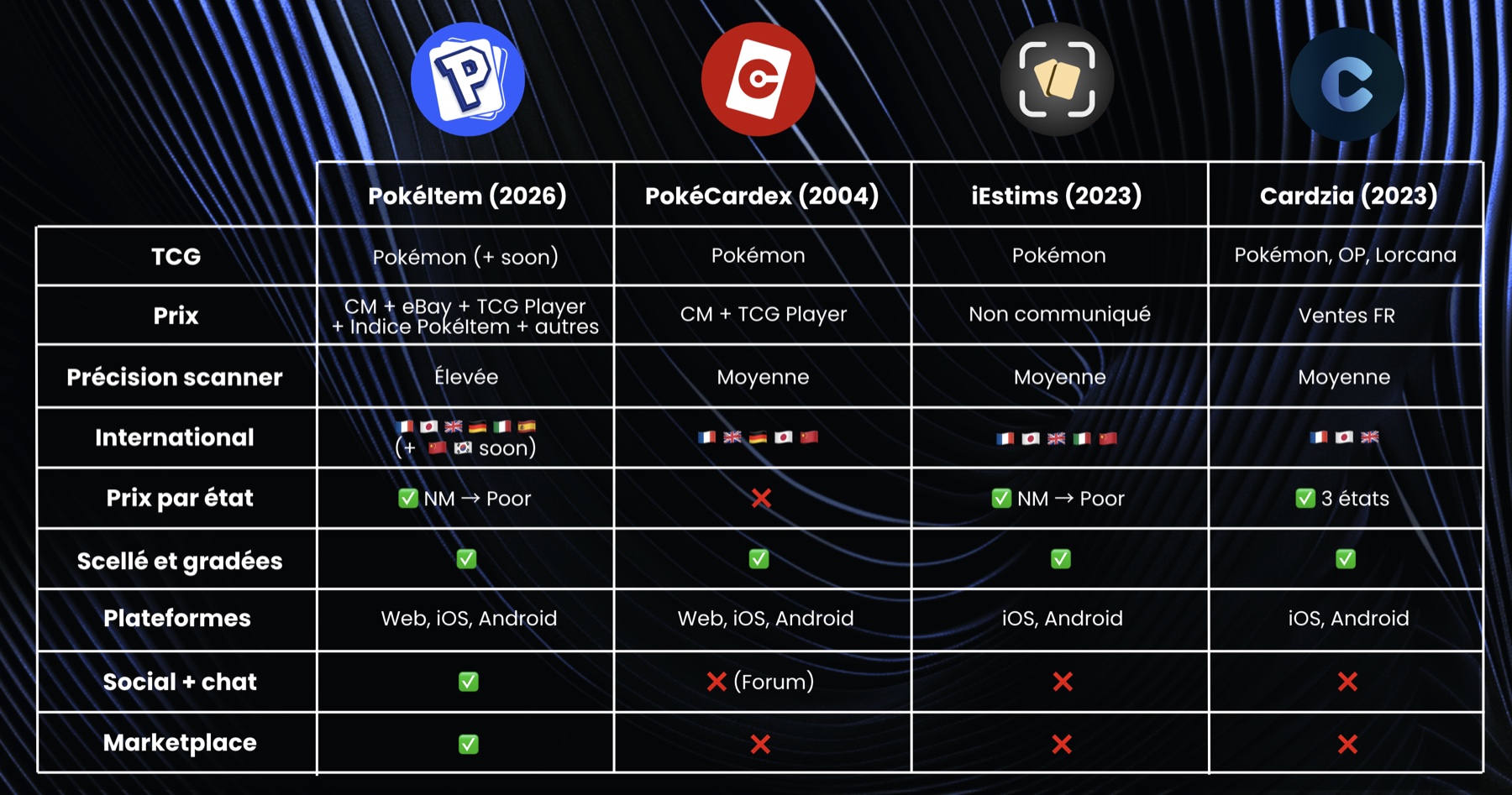
| PokéItem | PokéCardex | iEstims | Cardzia | |
|---|---|---|---|---|
| Platforms | Web, iOS, Android | Web, iOS, Android | iOS, Android | iOS, Android |
| TCGs covered | Pokemon - One Piece and Lorcana on the roadmap | Pokemon | Pokemon | Pokemon, One Piece, Lorcana |
| Price sources | Cardmarket, eBay and PokéItem index cross-referenced across multiple sources | Prices via API, links to Cardmarket | Comparison links to marketplaces | Real completed sales on the French market |
| Price by condition | Near Mint to Poor | Condition and grade entered, average price | By condition, rarity and edition | 3 tiers: New, Good, Poor |
| Sealed and graded cards | Yes | Yes | Yes | Yes |
| Network and messaging | Yes since v1.2.0 | Community forum | - | - |
| Buying and selling between collectors | Yes - integrated Marketplace | Member trades | - | Pre-filled listings for Vinted and Leboncoin |
| Offline mode | Yes | - | - | - |
Yes = announced by the publisher. - = not publicly announced as of 18 August 2026.
What PokéItem adds on the pricing side: the Cardmarket Near Mint price, the most recent completed eBay sales, and a PokéItem index cross-referenced across multiple sources and displayed with its confidence level - you always know where a price comes from. Valuation goes down to per-condition pricing, from Near Mint to Poor, and the catalogue covers six card languages (French, English, Italian, German, Spanish, Japanese), with Korean in preparation.
On the usage side: an integrated Marketplace where your listing is positioned against the market price and a "For me" filter surfaces only the cards you are missing, a collector network with public profiles, a showcase and an activity feed, a shop directory with live open/closed status, messaging (Premium, 16 and over), and an offline mode for conventions where the network does not hold up. PokéItem takes no commission and does not handle payment: the Marketplace connects buyers and sellers, and the transaction stays between collectors.
Our verdict on Cardzia
To sum up this Cardzia review: the app covers a specific use case well - quick estimation - and anchoring prices in French sales is consistent with that positioning. If your question stops at "how much is this card worth", it answers it.
What this comparison brings out is that a collection is not just a series of estimates. What matters after six months is knowing where a price comes from, what each copy is worth by condition, how the whole thing is evolving, and being able to do something with it: sell, buy, trade, show it off.
That is where PokéItem pulls ahead, on verifiable points:
- You know where every price comes from. Cardmarket Near Mint price, most recent completed eBay sales, and a PokéItem index cross-referenced across multiple sources, displayed with its confidence level. No number without an origin, and a wrong price can be flagged in one tap.
- Valuation goes down to the individual copy, from Near Mint to Poor.
- Six card languages - French, English, Italian, German, Spanish, Japanese - with Korean in preparation. A German or Japanese card finds its binder.
- Web, iOS and Android, the same account and the same collection everywhere, with an offline mode for conventions where the network does not hold up.
- An integrated Marketplace, collector network and messaging: sell your doubles to collectors who are looking for exactly that card, no commission, without leaving the app, and your listing is positioned against the market price.
- Multi-TCG is on the roadmap. One Piece and Lorcana, on the infrastructure already running OpItem in production.
The ambition is clear: to become the reference app for TCG, not just another price scanner. The best way to judge is to try it yourself, for free - up to 1,000 cards and 20 scans per month, in your browser at app.pokeitem.fr or by downloading the app.
Last updated: 18 August 2026
Back to blogAlso worth reading
Track your cards' value in real time
Scan your cards, organise your collection and get price alerts, all on PokéItem.