
Pokécardex review: how good is the original Pokémon TCG collection app?
Pokécardex is the historical reference for French-speaking Pokémon TCG collectors. Here is what the app does, what it costs, where it falls short, and how it compares to other collection apps in 2026.
Looking for an honest Pokécardex review before you commit? It is the historical reference for French-speaking Pokémon TCG collectors, and just about every French collector has visited the site at least once. The real question is not whether it is legitimate, it is, but how far it actually goes, and what you will need alongside it. Here is our take, sourced from information published by the developer, followed by what PokéItem does differently.
This article was last updated on 18 August 2026. The apps mentioned release updates every few weeks: check their store listings before making a decision.
What is Pokécardex?
Two things need to be separated here, because most comparisons mix them up.
The website is one of the oldest in the French-speaking ecosystem: web archives trace it back to March 2003. Twenty years of forum posts and card pages is a genuine head start in the French-speaking web.
The mobile app is far more recent: it launched in 2023, published by NUMELEK, based in Villeurbanne. It holds a rating of 4.8/5 across nearly 3,800 reviews on the App Store, and basic access is free.
What Pokécardex does
The forum, and twenty years of community
This is its strongest point. The forum is active every day: questions about a print variant, authentication of a suspicious card, discussions about new releases. If you need a place to ask a specific question and get an answer from someone who has been collecting for fifteen years, this is where that happens. The site also has a member trading section on the web. At PokéItem, the equivalent lives inside the app: a Marketplace where every listing is shown relative to the market price, an activity feed, and private messaging.
Detailed inventory
Collection management is thorough: you log each card with its version, condition, quantity, and language. You can add notes to graded cards, create custom binders, and track progress statistics. The wishlist is free for everyone. The catalogue also covers sealed products (booster packs, displays). PokéItem covers the same ground, with six card languages versus a handful, and an offline mode for conventions.
The scanner
The app scans a card, checks whether you already own it, and adds it to your collection. Unlimited scanning is reserved for Plus subscribers. No measured success rate is published, whereas PokéItem reports over 98% across more than 150,000 scans.
Prices pulled from two sources
Pokécardex shows the current price of each card and its trend, using data from Cardmarket and TCGPlayer. Two market references, one European and one American. But the displayed price is still an average: it does not break down by condition. PokéItem cross-references Cardmarket, completed eBay sales, and its own index, shows a confidence level for each price, and goes down to a price per condition from Near Mint to Poor. That is what separates a theoretical collection value from a real one.
Free and ad-free
Basic access is free and the app shows no advertising. Unlimited scanning requires a Plus subscription.
Four limits worth knowing
The price is an average, not a per-condition figure. Condition is recorded in your inventory, but the displayed valuation does not break down by condition. If you track a collection where the gap between a Near Mint copy and a played one runs into tens of euros, that granularity will be missing.
Purchases are not shared between iOS and Android. A Plus subscription taken out on Android does not carry over if you switch to an iPhone. Worth knowing before you subscribe.
No in-app buying or selling, and no messaging. Member trading happens on the website, in the forum and the dedicated section, not in a Marketplace tied to market prices, and there is no private conversation inside the app.
Pokemon only.
How much does Pokécardex Plus cost?
Basic access is free. The Pokécardex Plus subscription unlocks unlimited scanning and advanced statistics, at the following prices on the App Store:
- 1.99 euros per week
- 3.99 euros per month
- 39.99 euros per year
A price that matches the scope: collection tracking, without an integrated Marketplace, without messaging, without per-condition pricing or an offline mode. And the subscription is tied to the app store you used to purchase it, which is not the case with PokéItem.
The scanner, point by point
Scanning is the most-used action in any collection app, so it deserves the most detail. Three concrete differences, as stated by the developers:
- Success rate. PokéItem's recognition succeeds on more than 98% of scans, measured across more than 150,000 scans as of 18 August 2026, in under three seconds with a good connection. The target set for 2027 is to exceed 99% success in under one second. None of the other three apps publish a measured success rate.
- What the scan identifies. PokéItem recognises the card, its rarity and its language: scan a German or Japanese card and it suggests the right binder. None of the other three apps announce card language identification.
- Volume. PokéItem Premium members can scan an entire binder page in one shot (beta), instead of card by card. This is the only page-level scan in the comparison.
- The trial. On PokéItem, the scanner can be tested without creating an account, and scans are doubled during the first month after sign-up.
And beyond the scan, the valuation does not stop at a single number: the recognised card is priced by condition, from Near Mint to Poor, with the price source displayed.
Pokécardex or PokéItem: which one to choose?
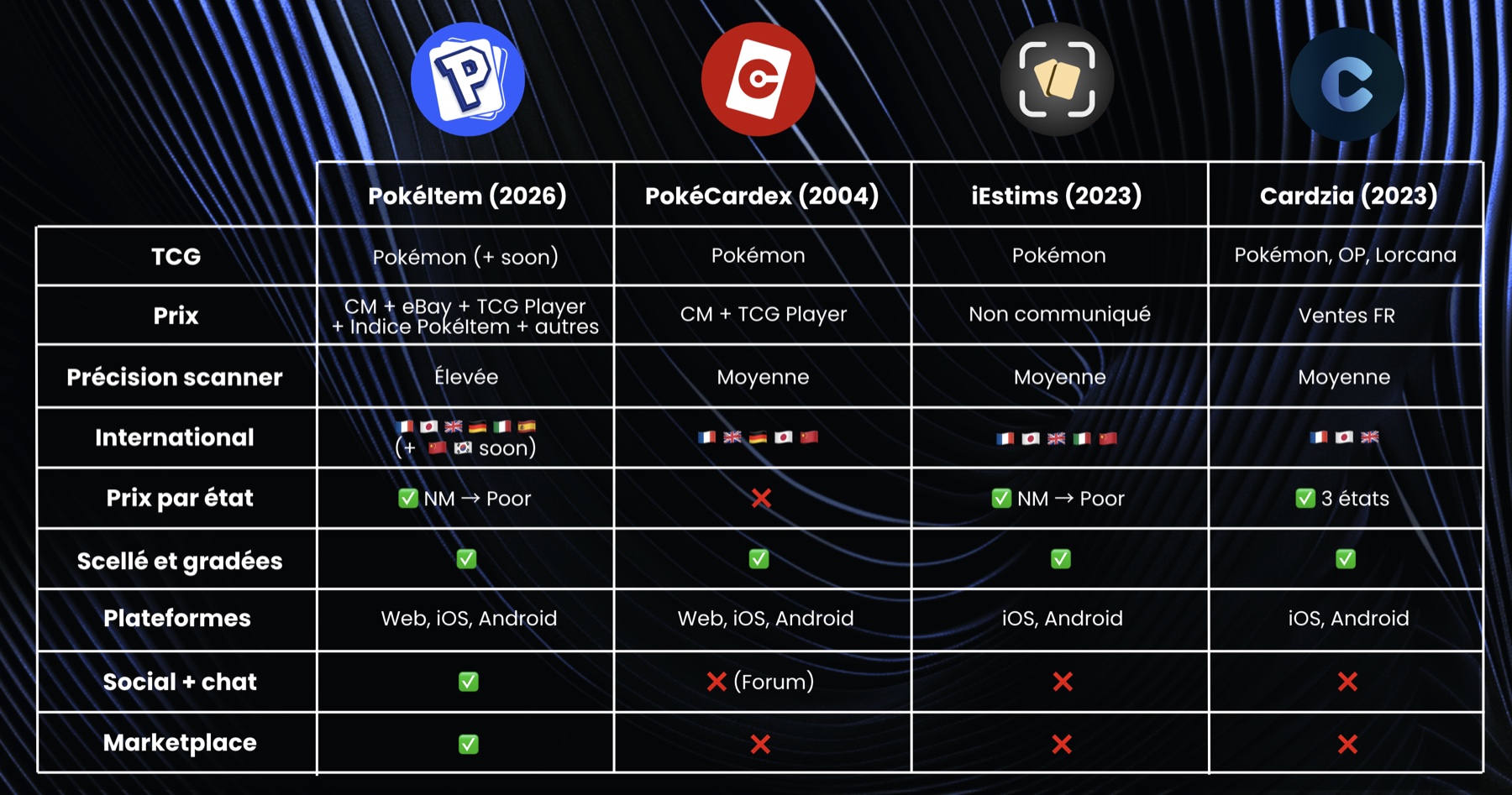
Both overlap on catalogue, scanner, and collection tracking, and diverge on what you do with the value afterwards. Here is how the four French-language apps compare, as of 18 August 2026:
| PokéItem | PokéCardex | iEstims | Cardzia | |
|---|---|---|---|---|
| Platforms | Web, iOS, Android | Web, iOS, Android | iOS, Android | iOS, Android |
| TCGs covered | Pokemon - One Piece and Lorcana on the roadmap | Pokemon | Pokemon | Pokemon, One Piece, Lorcana |
| Price sources | Cardmarket, eBay and PokéItem index cross-referenced across multiple sources | Cardmarket and TCGPlayer | Comparison links to marketplaces | Real sales from the French market |
| Price by condition | Near Mint to Poor | Condition logged, average price | By condition, rarity and edition | 3 conditions: New, Good, Poor |
| Sealed and graded cards | Yes | Yes | Yes | Yes |
| Network and messaging | Yes since 1.2.0 | Community forum | - | - |
| Collector-to-collector buying and selling | Yes - integrated Marketplace | Member trading on the website | - | Pre-filled listings for Vinted and Leboncoin |
| Offline mode | Yes | - | - | - |
Yes = announced by the developer. - = not publicly announced as of 18 August 2026.
On catalogue and inventory, both apps are in the same league. The difference comes down to three areas.
Pricing depth. PokéItem cross-references the Cardmarket Near Mint price, recent completed eBay sales, and a PokéItem index calculated across multiple sources, displayed with a confidence level. You always know where a number comes from, and you can flag an incorrect price in one tap. Valuation goes down to the price per condition, from Near Mint to Poor, which changes the estimated value of a real collection where not everything is in perfect shape.
International coverage. Six card languages, French, English, Italian, German, Spanish, and Japanese, with Korean in preparation. A German or Japanese card finds its binder instead of sitting outside the catalogue.
What you do with your collection. Since version 1.2.0, PokéItem includes a Marketplace between collectors where every listing is shown relative to the market price, with a "For me" filter limited to cards you are missing; a network of public profiles with a showcase and activity feed; a shop directory with open or closed status calculated in real time based on each shop's time zone; messaging between collectors who follow each other; and an offline mode that keeps your collection accessible at conventions. PokéItem takes no commission and does not handle payment: the Marketplace connects people, and the transaction stays between collectors.
Our verdict on Pokécardex
To sum up this Pokécardex review: the forum and twenty years of archives remain its main asset, and that is where to go for a specific question about a variant.
What this comparison brings out is that the question is no longer whether the inventory is well managed, it is on both sides, but what your collection lets you do next. Knowing the real value of each copy by condition, knowing where the price comes from, managing cards in six languages, selling to someone who is specifically looking for that card without leaving the app, and finding the nearest open shop.
That is the ground PokéItem is built on, and on verifiable points:
- Every price shows its source, Cardmarket, completed eBay sales, cross-referenced multi-source index with its confidence level.
- Valuation goes down to the individual copy, from Near Mint to Poor.
- Six card languages, Korean in preparation.
- Web, iOS and Android, one account everywhere, offline mode included, and a subscription that does not depend on which app store you used.
- An integrated Marketplace, network and messaging, with no commission.
- Multi-TCG is on the roadmap: One Piece and Lorcana, on the same infrastructure already running OpItem in production.
The ambition is clear: to become the reference app for TCG, not just a solid collection manager. Judge for yourself without paying anything. Up to 1,000 cards and 20 scans per month, in your browser at app.pokeitem.fr or by downloading the app.
Last updated: 18 August 2026
Back to blogAlso worth reading
Track your cards' value in real time
Scan your cards, organise your collection and get price alerts, all on PokéItem.