
Pokémon Card Scanner: the Best Apps in 2026
Scanning a Pokémon card in a few seconds is possible. Discover the best pokemon card scanner apps and how they really work.
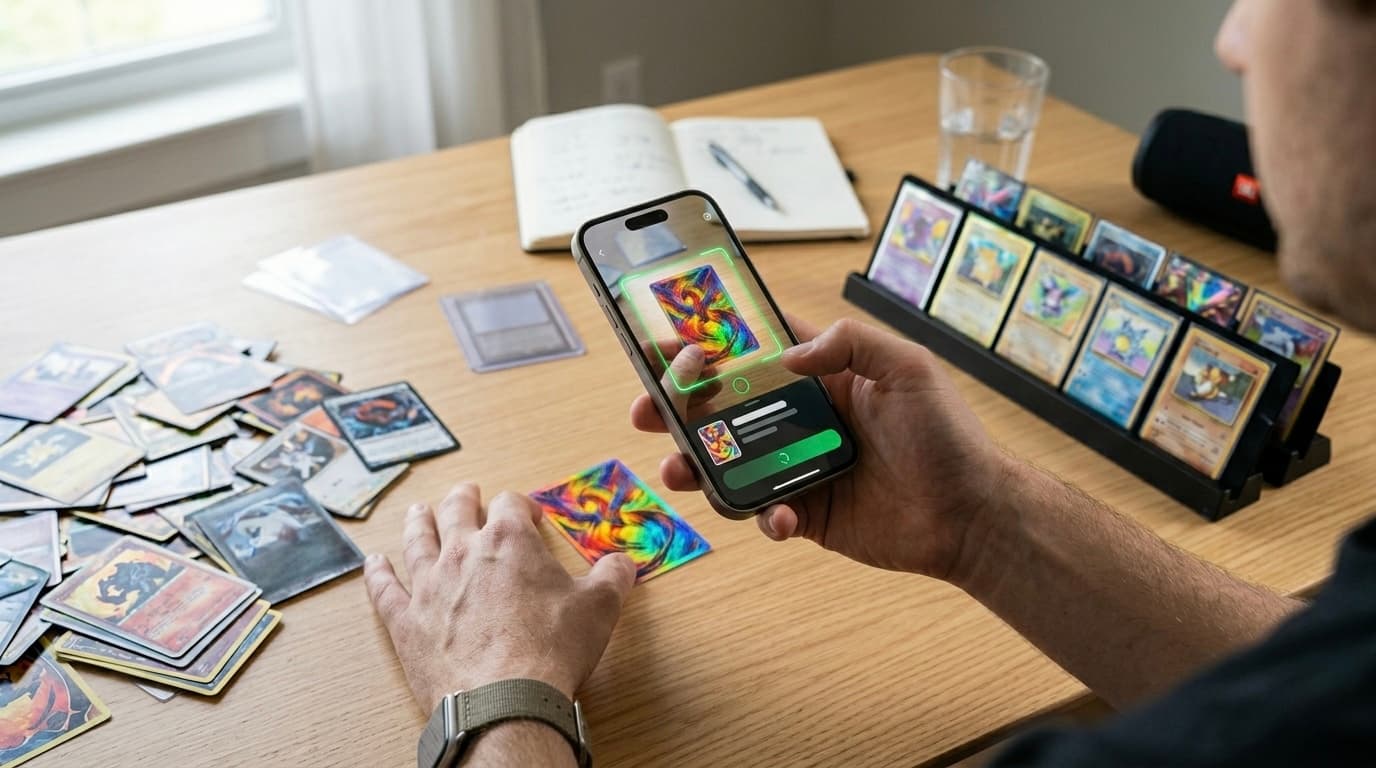
You find an old box of cards in a drawer, you inherit a collection, or you come home from a garage sale with a hundred cards under your arm. The question is immediate: how much is it worth? Identifying each card by hand, looking up the set, the number, comparing across several marketplaces, takes hours of work. That is exactly why the pokemon card scanner has become collectors' number-one tool in 2026. In a few seconds, your phone identifies the card and displays its name, set, rarity, and current market value. This guide walks you through how it works, which apps to choose, and how to get the most out of automatic recognition to manage your collection.
Why collectors need a Pokémon card scanner
Today, the physical Pokémon TCG catalog exceeds 20,000 cards for the Western releases alone. Between print variants, Full Arts, Alt Arts, reverse holo versions, and promotional cards, identifying a card precisely without outside help is a feat, even for an experienced collector.
The situations where a scanner becomes essential are very concrete:
- Sorting a bulk lot you bought: before buying 500 cards at €10 a box, you want to know in 5 minutes what is worth keeping.
- Checking the market value before a transaction: never sell or buy without knowing the real value on the secondary market.
- Cataloging an existing collection: entering each card manually into a spreadsheet takes days. A scanner cuts that time to a few hours.
- Spotting a rare card in the middle of a binder: some little-known cards can be worth several dozen euros without their outward appearance hinting at it.
The manual solution, looking the card up on CardMarket or TCGPlayer, finding the right number, comparing versions, is still fine for 5 cards. It becomes unrealistic beyond 50. That is where automated pokemon card recognition really changes the game.
How a Pokémon card scanner works
Behind the apparent magic of a one-second scan lies a very real technology: computer vision combined with artificial intelligence.
The technical chain in detail
When you point your camera at a card, here is what happens:
- Edge detection: the app identifies the card's borders in the image. Modern engines do this even in difficult lighting conditions.
- Visual feature extraction: the AI model analyzes the artwork, the dominant colors, the printed text, and the rarity symbols.
- Comparison against the database: these features are compared to thousands of stored references. For example, the MonPrice app advertises a model trained on more than 19,000 cards to achieve high recognition accuracy.
- Instant result: usually in under 2 seconds, the card is identified with its set, number, language, and variant.
What the scanner reads, and what it can miss
Current scanners handle cards in good condition from recent sets very well. A few cases remain tricky:
- Holographic cards: reflections can disrupt the reading. Some apps include special algorithms for foils.
- Poor lighting: too little or too much light remains the scanner's number-one enemy. Soft natural light or a well-placed desk lamp gives the best results.
- Very old cards: Base Set editions and the Wizards of the Coast series from 1999 - 2003 are less well covered by some databases.
- Close variants: between a normal version, reverse holo, and Full Art of the same card, recognition may hesitate and offer several choices.
The practical tip: for valuable cards, the scanner is an excellent first filter. For a card worth more than €20, a manual check on CardMarket is still recommended to confirm the exact version.
PokeItem: scan and manage your collection in one place
Among the pokemon scanner apps available in 2026, PokeItem (available at app.pokeitem.fr) positions itself as a solution designed specifically for collectors in the European market who want to go beyond simple identification.
The idea behind PokeItem is simple: the scan is just the entry point for your data. What matters next is what you do with it.
What PokeItem brings in concrete terms
The built-in scanner lets you quickly identify any card in your collection. You point your camera, the card is recognized, and it can be added to your inventory immediately. No need to look up the set by hand or type the number.
But PokeItem's real strength comes from what follows the scan:
- Real-time price tracking: the prices shown come from the European secondary market, the reference for French-speaking collectors who buy and sell in euros.
- Estimated total collection value: once your cards are recorded, you can see at a glance what your entire collection is worth at the current market price.
- Advanced filters: you can sort by set, rarity, type, or price range to analyze your collection in detail.
- Built-in wishlist: flag the cards you're missing to complete a set or build a deck.
- Responsive interface: PokeItem works just as well on mobile during a flea market as on desktop for an in-depth cataloging session.
The app is free to access (freemium model) and designed for the physical Pokémon TCG, not for TCG Pocket, not for TCG Live. If you collect printed cards, it's the tool made for you.
A concrete use case
You come back from a card swap meet with 80 cards bought as a lot. You launch PokeItem on your phone and scan card after card on the way home. By the time you get home, your collection is already updated, the lot's total value is calculated in euros, and you know exactly which cards deserve a protective sleeve.
The other solutions on the market in 2026
The pokemon card scan app market has grown strongly over the past two years. Here are the main alternatives, with their respective strengths.
PokéCardex
PokéCardex is the historical French-speaking reference app for collection management. It offers a built-in card scanner, a database of more than 23,000 Western cards and 24,000 Japanese cards, and also works in offline mode, an advantage for scanning without an internet connection, with later synchronization.
The scanner is available without limit only with the PokéCardex Plus subscription. Free users get 20 scans to test the feature. The prices shown come from CardMarket and TCGPlayer.
PokéCardex is ideal for collectors who want a native mobile app (iOS and Android) with a strong French-speaking community around it.
TCGPlayer (official app)
The official TCGPlayer app offers a scanner directly connected to its marketplace. After a major update in August 2025, the scan engine was completely rebuilt for speed and accuracy, and now covers every TCG available on the platform.
TCGPlayer's strength is its direct integration with the American buy/resell market. Prices are in USD and reflect the North American market. For a European collector, it's a useful reference for understanding global trends, but euro prices on CardMarket remain more relevant day to day.
MonPrice
MonPrice is a multi-TCG app available on Android, whose AI model was trained on more than 19,000 cards for recognition. It offers price tracking and export to CSV or JSON, handy for collectors who manage their inventory in a spreadsheet. Scan access is limited in the free version.
VeraDex
VeraDex is a French solution in development whose recognition engine is based on computer vision. Value estimation is based on CardMarket data, which makes it relevant for the European market. It covers French, English, and Japanese editions.
Eyevo
Eyevo is a Pokémon-specialized scanner whose AI model is trained exclusively on Pokémon cards. The app claims recognition in under a second with more than 95% accuracy according to its developers, a strong point for volume scanning (entire binders, large lots). It is available on iOS.
What sets a good scanner app apart in 2026
Faced with the multitude of options available, here are the concrete criteria for choosing the scan pokemon cards phone app that matches your usage:
1. The price source
This is the number-one criterion for a French-speaking collector. A USD price on the American market doesn't match the real euro price on the European secondary market. Make sure the app you choose relies on CardMarket (the EU reference) or displays euro prices consistent with real transactions.
2. Database coverage
New Pokémon TCG sets come out several times a year. A good app must be updated regularly to include new cards in its recognition database. An app that doesn't recognize the last 6 months of releases loses much of its value.
3. The number of scans available in the free version
Many apps limit scans in their free version. This is an important factor if you have a large collection to catalog. Some apply a daily quota, others a lifetime global quota, the terms vary widely from one app to another.
4. Collection integration
A standalone scanner is handy for a one-off estimate. But if the app also lets you store your collection, track its overall value, and manage a wishlist, you centralize everything in a single tool. That's a considerable time saver over the long run.
5. Variant handling
A Pokémon card can exist in a normal version, reverse holo, Full Art, Alt Art, or even a Japanese version. The app must be able to distinguish these variants because their market values can vary tenfold. This is often where less sophisticated scanners show their limits.
6. OS compatibility and interface quality
Mobile or web? iOS or Android? A slow or confusing interface makes cataloging painful even in a short session. Always test an app on a few cards before committing to a long session.
Using a Pokémon card scanner well: best practices
A few simple habits make a real difference in practice:
- Natural light or diffuse white light: avoid direct reflections on holographic cards.
- Card flat and stable: a slight movement during the scan is enough to throw off recognition.
- Take the card out of its sleeve if recognition fails: the protective plastic can create reflections that disrupt the AI.
- Always confirm the version for valuable cards: the scanner offers an identification, but for a card at €30 or more, a manual check on CardMarket takes 30 seconds and saves you a costly mistake.
- Scan the right way up: some apps recognize cards held vertically better. Try both orientations if recognition fails on the first attempt.
Conclusion
The pokemon card scanner is now an essential reflex for any serious collector. Whether you have 50 or 5,000 cards, automatic recognition saves you precious time, and above all, it lets you make better buying, selling, and storage decisions.
In 2026, solutions are plentiful: PokéCardex for the French-speaking mobile community, TCGPlayer for the American market, Eyevo for pure speed, VeraDex for the European market. And if you want a web solution that combines a scanner, euro price tracking, total collection value, and advanced filters in a single tool designed for the French-speaking market, PokeItem is made for you. Its scanner was in fact completely rebuilt with version 2: far more accurate on full-arts, alt-arts, and secret rares with tiny numbers, with automatic capture and card-language detection.
👉 Try PokeItem for free at app.pokeitem.fr and scan your first card today.
Last updated: 16 April 2026
Back to blogAlso worth reading



Track your cards' value in real time
Scan your cards, organise your collection and get price alerts, all on PokéItem.