
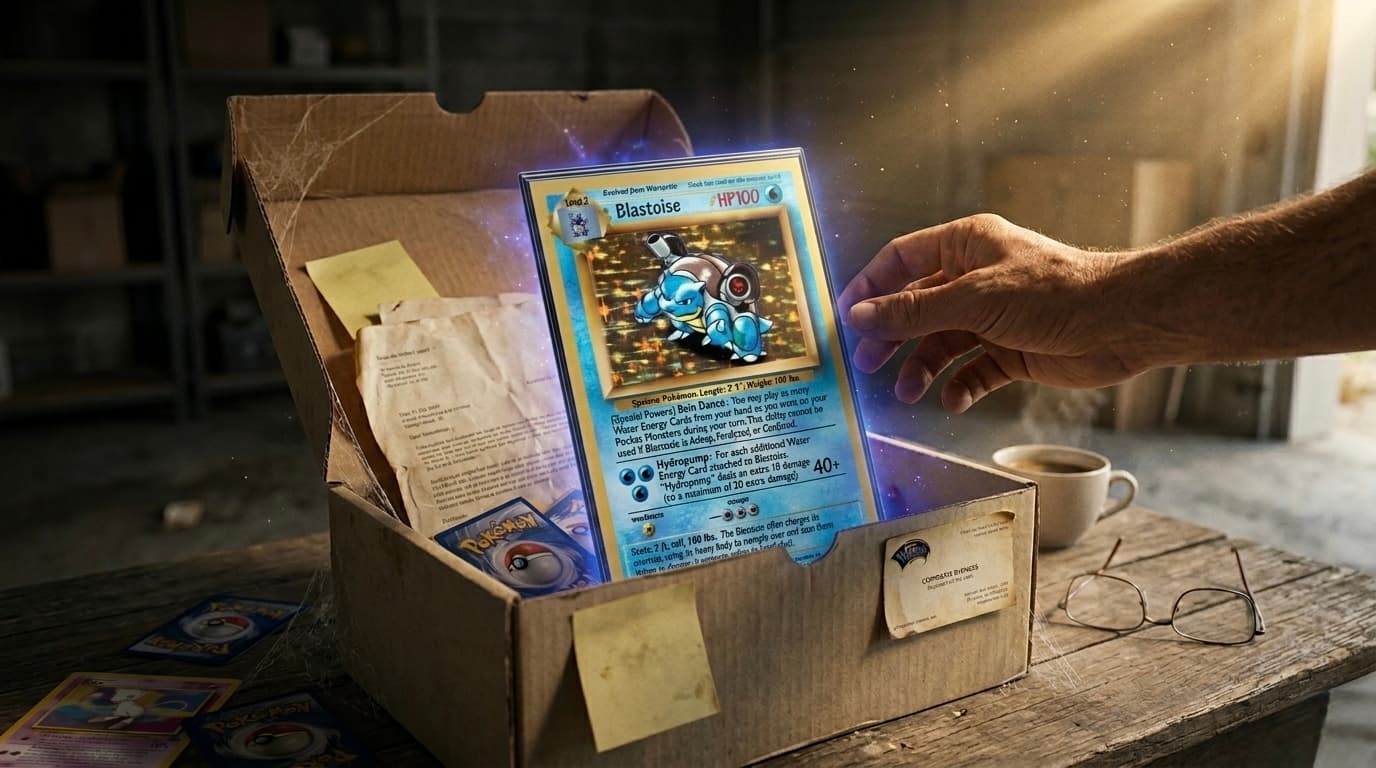
Blastoise Galaxy Star: the unique prototype sold for $360,000
In 1998, Creatures Inc. created a unique prototype to win over Wizards of the Coast. This Blastoise Galaxy Star card would sell for $360,000 in 2021.
Blastoise Galaxy Star prototype rare card: the story of the specimen sold for $360,000
There are rare Pokémon cards. There are precious ones. And then there's one, a single one, that should never have left the desk of a Wizards of the Coast executive. The Blastoise Galaxy Star prototype rare card is in that last category: a unique object, born behind the scenes of a business negotiation in 1998, found decades later by a Texan collector, and sold at auction for 360,000 dollars in 2021. Here's its story.
1998: Pokémon looks for an American partner
To understand what the Blastoise Galaxy Star is, you have to go back to a time when Pokémon wasn't yet the global franchise we know. In 1997 and 1998, the Pokémon trading card game was a smash hit in Japan. Media Factory published the cards, the game sold, kids snapped up the boosters. But internationally, everything was still to be built.
Creatures Inc., one of the companies that co-owns the Pokémon franchise alongside Game Freak and Nintendo, was then looking for a partner able to localize and distribute the Pokémon TCG in the United States. Their target: Wizards of the Coast, the American publisher already famous for Magic: The Gathering. A meeting was arranged. And to convince, you have to impress.
Creatures Inc. then had a series of presentation cards produced. These cards were not meant to be played, sold, or collected by the general public. They were created for a single purpose: to show the executives of Wizards of the Coast what the game might look like in an English version, with a layout adapted to the American market. These are presentation prototypes, printed in very small quantities, perhaps even a single copy for some.
Among these cards were a Squirtle, a Mewtwo, and above all… a Blastoise. Not just any Blastoise.
A card like no other: the Galaxy Star
The Blastoise Galaxy Star owes its nickname to its background artwork: a starry pattern, evoking a galaxy, printed directly onto the card. This design never existed in the official TCG. It belongs to no set, no promo edition, no limited series. It's a graphic creation specific to these presentation documents, designed to be visually striking during a business meeting.
The card is printed in English, which is rare for documents of this era, when the TCG didn't yet officially exist outside Japan. It carries stats, a Blastoise illustration, and that characteristic starry background that would give it its name decades later in the collector community.
The negotiation succeeded. Wizards of the Coast agreed to distribute the Pokémon TCG in the United States. The English Base Set was released in January 1999 and became a global cultural phenomenon. As for the presentation prototypes, they vanished into the archives, or into the pockets of a few people present that day.
Bob Croft and the discovery of a unique object
Years passed. Decades, even. And that's where Bob Croft enters the scene, an American collector from Texas whose name is today inseparable from the story of the Blastoise Galaxy Star.
Bob Croft is no novice. He's a seasoned collector, specializing in rare objects and memorabilia. At some point, the exact details of the transaction aren't all public, he acquired a lot that contained this prototype. According to information reported at the auction, he reportedly paid around 2 dollars for the entire lot in which the card was found.
When Croft realized what he had in his hands, the object was submitted for authentication. The card was sent to PSA (Professional Sports Authenticator), the main card grading body in the United States. PSA examined the card, confirmed its authenticity and origin, and gave it a grade of PSA 7, meaning the card is in good condition, with minor imperfections, but authenticated beyond any doubt.
The existence of the Blastoise Galaxy Star then became known in collector circles. And very quickly, the question arose: how much can an object that exists in only a single copy in the entire world be worth?
January 2021: 360,000 dollars at auction
The sale took place in January 2021, organized by the auction house Heritage Auctions. The event was closely followed by the global community of Pokémon card collectors, who were then living through a period of particular excitement: the rare card market was in full explosion, boosted by a general resurgence of interest in the TCG and by several record sales following one after another.
The Blastoise Galaxy Star prototype rare card, graded PSA 7, went up for auction. The hammer fell at 360,000 dollars.
To put things in perspective: Bob Croft had acquired the lot for 2 dollars. The card alone sold for 360,000 dollars. It's one of the most spectacular returns on investment in the history of the Pokémon TCG, even if, in this specific case, no one knew what the lot contained at the time of purchase.
This sale positions the Blastoise Galaxy Star among the most expensive Pokémon cards ever sold, alongside the Pikachu Illustrator and a handful of other exceptional pieces. But unlike those, of which several graded copies exist, the Blastoise Galaxy Star is, to this day, the only one known in the world.
What this story tells us about the Pokémon TCG
The story of the Blastoise Galaxy Star isn't just that of a record sale. It's the tale of an object that could have disappeared into an archive, ended up in a dumpster, or remained unknown forever. It's also a testament to a pivotal era: the one when two companies sat down at a table to decide whether Pokémon would conquer the Western world. It's fair to say the decision was the right one.
This prototype also illustrates something fundamental in Pokémon TCG culture: the most precious objects aren't always the ones made in large quantities. Sometimes, absolute rarity, uniqueness, creates a value that nothing else can approach.
Of course, the average collector will never find a Blastoise Galaxy Star in an old 2-dollar lot. But this story is a reminder of why so many enthusiasts keep exploring the corners of the market, digging through forgotten collections, and taking an interest in the history of the cards they own.
Track the value of your rare Pokémon cards
You may not have a $360,000 prototype in your collection, but some of your cards may be worth more than you think. On PokeItem, you can track the value of your Pokémon cards in real time, check sales history and stay informed of market movements. A useful resource for any serious collector who wants to know the real value of what they own.
Last updated: 19 July 2026
Back to blogAlso worth reading
Track your cards' value day by day
Scan your cards, organise your collection and get price alerts, all on PokéItem.