
Investing in Pokémon Cards in 2026: The Complete Guide
Global market, graded singles, vintage sealed, PSA: everything you need to know to invest in Pokémon cards in 2026 with a clear method.
Investing in Pokémon cards in 2026 means navigating a market that exceeds 8 billion dollars worldwide, a figure that would have seemed absurd ten years ago. The 2020-2021 frenzy is now firmly in the past, but the market has matured, professionalized, and continues to offer real opportunities for those who know where to look. Whether you are thinking about a long-term Pokémon card portfolio, want to buy and sell Pokémon cards in the short term, or simply want to understand the returns before spending your first note, this guide gives you the keys to the 2026 market.
The TCG Market in 2026: Context
The global trading card market is estimated at between 8.06 and 9.2 billion dollars in 2026, according to analysis firms Mordor Intelligence and GM Insights (the scope varies depending on the source: some cover only competitive play, others the entire secondary market). Pokémon accounts for more than 12% of the global TCG market in 2025, making it the dominant franchise in the sector.
The projection to 2035 is ambitious: around 16.9 billion dollars, representing a compound annual growth rate of approximately 6.9%. The US market alone was worth around 2.2 billion dollars in 2025, with annual growth of 8% expected over the decade.
A few indicators that show how mature the market has become:
- Sales of graded Pokémon cards on StockX grew by +339% in 2025
- More than 80% of cards sold above 500 EUR are certified by a grading organization
- The 18-34 age group accounts for 57% of the TCG IP market
- PSA has graded more Pokémon cards than any other category for two consecutive years
The 2024-2026 correction: after the post-Covid overheating, the market is going through a healthy correction. Modern common cards are suffering from overproduction (The Pokémon Company produced 11.9 billion cards during fiscal year 2023-2024). But chase cards (SIR, IR, Hyper Rare), vintage sealed products, and exclusive Japanese promos continue to gain value. This segmentation is something every serious investor needs to understand.
Investment Segment Analysis: Prices and Returns
Not every Pokémon card investment is equal. There are three main categories, each with its own risk profile and return potential.
Modern Chase Card Singles
Modern rare cards (Illustration Rare, Special Illustration Rare, Hyper Rare) concentrate the bulk of the value in recent sets. Massive print runs push common card prices toward zero, but chase cards remain scarce by design.
| Card | Estimated Raw Price | PSA 10 Graded (estimate) | Multiplier |
|---|---|---|---|
| Umbreon ex SIR Prismatic Evolutions | 800-900 EUR | 4,000-18,000 EUR (to be confirmed) | 5-20x |
| Umbreon VMAX Alt Art Evolving Skies | 1,200-1,500 EUR | variable | variable |
| Charizard VMAX Rainbow Rebel Clash | 450-600 EUR | variable | 5-15x |
Note: raw prices come from third-party sources (April-August 2026). Always cross-check with CardMarket before buying or selling.
The general rule: cards worth more than 100 EUR raw see their value increase by 120% to 300% in PSA 10 on average. That is the main lever grading provides on modern chase cards.
Vintage Cards: The Long-Term Investment Par Excellence
The 1st Edition Base Set Charizard PSA 10 trades between 300,000 and 420,000 dollars. The absolute market record now belongs to the Pikachu Illustrator PSA 10, sold for 16.49 million dollars in February 2026 at Goldin Auctions (a widely reported figure, but source it directly on the Goldin Auctions website for rigorous editorial use).
These levels are out of reach for most people, but vintage cards graded PSA 9-10 have generated an average of +15% per year since 2019 across all cards. That is a return that outperforms many traditional investments over the same period.
What protects vintage value:
- Limited and known print runs (no possibility of "reprinting" a 1st Edition)
- Growing nostalgic demand (the generation that grew up with Pokémon is now 25-40 years old and has purchasing power)
- Absolute scarcity of copies in good condition
Sealed Products: Patience Rewarded
A French booster box costs between 170 and 250 EUR depending on the set. Sealed investment rests on a simple principle: a sealed box gains value over time once the set is discontinued, especially if it contains popular chase cards.
Vintage sealed products continue to gain value according to current market data. That said, this segment requires capital tied up for several years and storage space (strict conservation conditions: humidity, light, temperature).
How to Find the Right Prices
Pricing methodology matters just as much as card selection. A bad purchase price wipes out any prospect of a return.
Reference Sources
CardMarket remains the essential reference for the European secondary singles market. The seller commission is 5%. The "trend" price on CardMarket is the most reliable indicator for French and European cards. Note: the site requires an authenticated session to access real-time data.
TCGPlayer (an eBay subsidiary since August 2022) is the American reference, with prices in USD. Relevant if you are targeting the US market or buying English cards, but less suited for pricing French cards.
eBay: completed sales ("sold listings") are more reliable than asking prices for assessing the real value of a card or lot.
PSA and auction houses (Heritage Auctions, Goldin Auctions): for vintage and high-end graded cards.
PokéItem as a Tracking Hub
Rather than juggling multiple tabs, PokéItem centralizes your collection tracking with integrated European secondary market prices. You can monitor your total collection value in real time, build a wishlist of cards you are looking for, and filter by set, rarity, or price range, without having to open CardMarket manually for every single card. This is especially useful when you are managing several dozen or several hundred cards at once.
The Factors That Influence a Pokémon Card's Value
Understanding what drives a card's value is essential for any informed Pokémon card investment. These factors interact with one another.
1. Rarity and Type
Special Illustration Rare (SIR), Illustration Rare (IR), and Hyper Rare cards concentrate the highest valuations in modern sets. Common cards, produced in the billions, do not make a serious investment.
2. Condition and Grading
This is probably the most decisive factor for valuable cards. More than 80% of cards sold above 500 EUR are graded. PSA remains the reference organization with the best resale premiums. CGC positions itself as a cheaper alternative (from 15 dollars versus 25 dollars and up at PSA), which can make sense for mid-range cards.
PSA 10 rates by language:
- Japanese cards: 60-70% chance of receiving a PSA 10 (more precise printing, superior quality)
- English cards: 40-50%
This difference explains the growing appeal of Japanese cards for investors: a better PSA 10 rate at a cost that is often lower. Note: PSA raised its fees in February 2026 (minimum viable threshold for Japanese submissions raised to 15,000 yen, up from 11,000).
3. Language and Origin
Exclusive Japanese promos (not distributed in Europe) and limited-edition Asian cards are segments that continue to gain value. The Japanese market has its own price dynamics, often disconnected from the Western market.
4. Set and Print Run
A popular set with strong chase cards (Evolving Skies, Prismatic Evolutions, Pokémon Card 151) generates more demand than a secondary set. The total print run of the set also matters: the more limited it is, the faster rare cards become scarce on the secondary market.
5. The Pokémon
Charizard, Pikachu, Dracovish, Umbreon, Mewtwo: certain Pokémon have a fanbase that sustains demand regardless of illustration quality. Investing in franchise pillars reduces demand-side risk.
Practical Tips for Buying, Selling, and Managing Your Investment
Before You Buy
- Check the CardMarket trend price in real time before any purchase (prices can move quickly after an official announcement)
- Assess the card's condition against PSA criteria if you plan to grade it (centering, corners, surface, edges)
- Factor grading costs into your purchase price: PSA fees plus postage can represent 30 to 80 EUR per card depending on the service chosen
- Avoid impulse purchases during live openings or drops: prices tend to fall in the weeks following a release
Buying to Resell: Pitfalls to Avoid
Buying and selling Pokémon cards is an activity that demands discipline. Classic mistakes:
- Buying at the peak right after a set release
- Ignoring postage, commission, and packaging costs when calculating your margin
- Grading a card worth 20 EUR raw (grading fees cancel out any profit)
- Holding a card too long after the hype has faded
Practical rule: PSA grading is only really worthwhile from 80-100 EUR raw value for modern cards.
Diversifying Your Portfolio
Like any investment, diversification reduces risk. A typical allocation for an intermediate Pokémon investor might look like this:
- 40-50% in modern chase cards with strong grading potential
- 30-40% in vintage or recent high-demand sealed products
- 10-20% in graded vintage cards (if budget allows)
This is not financial advice: it is simply the approach observed among serious collector-investors in the French-speaking market.
Tracking Your Collection's Performance
With dozens or hundreds of cards to manage, manual tracking quickly becomes unworkable. That is why a dedicated tool makes all the difference: centralizing prices, visualizing total value, spotting cards whose value is rising. These are all tasks that PokéItem automates for you.
Risks Not to Underestimate
A guide on Pokémon card investment would be incomplete without addressing the risks.
Market risk: a poorly received set or the saturation of a particular Pokémon can send a card down 40-50% in a matter of weeks.
Liquidity risk: some cards are hard to sell quickly without taking a discount. The market for very expensive cards (1,000 EUR+) is thin.
Counterfeit risk: fake sealed products exist. We cover this in our dedicated article on spotting fake Pokémon sealed products.
Overproduction risk: The Pokémon Company is printing increasing volumes. 11.9 billion cards in fiscal year 2023-2024. This structurally weighs on the value of common cards and even some rares from large sets.
Tax risk: in France, capital gains on personal property are taxable above a certain threshold (check with a tax advisor based on your situation).
Conclusion: Investing in Pokémon Cards in 2026, Yes, But With Method
Investing in Pokémon cards in 2026 is possible and potentially profitable, provided you choose the right segments (graded chase cards, vintage, selective sealed) and avoid the traps of the mass market. The global TCG market continues its structural progression toward 16.9 billion dollars by 2035, and Pokémon remains its main driver.
The key is real-time information and rigorous collection tracking. To get started, create your collection on PokéItem in your browser, or download the app on your phone to manage your collection and track your prices wherever you are. Free, no hidden fees, built for serious collectors.
Prices cited in this article come from third-party sources (April-August 2026) and may have changed. Always cross-check with CardMarket and selling platforms before making any buying or selling decision. This article does not constitute financial investment advice.
Last updated: 12 August 2026
Back to blogAlso worth reading
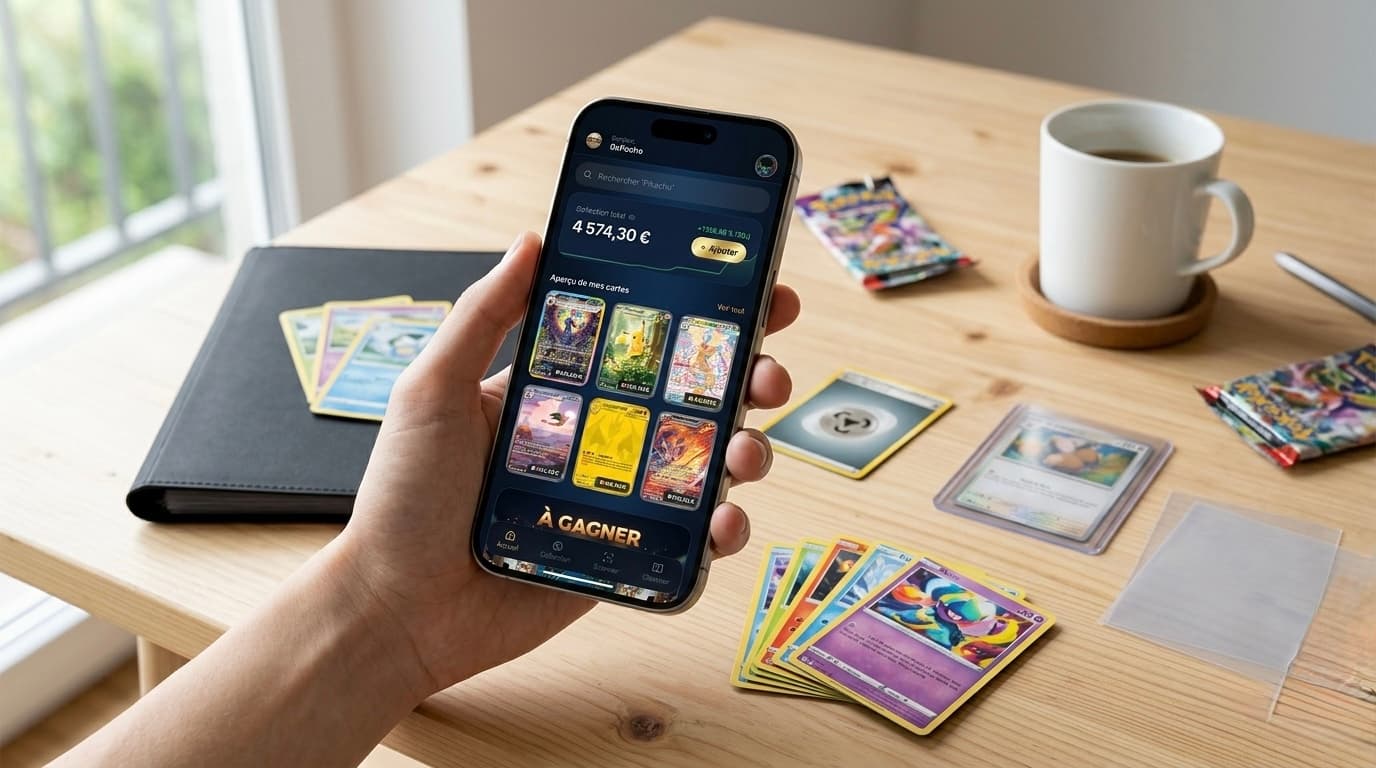
Track your cards' value day by day
Scan your cards, organise your collection and get price alerts, all on PokéItem.