
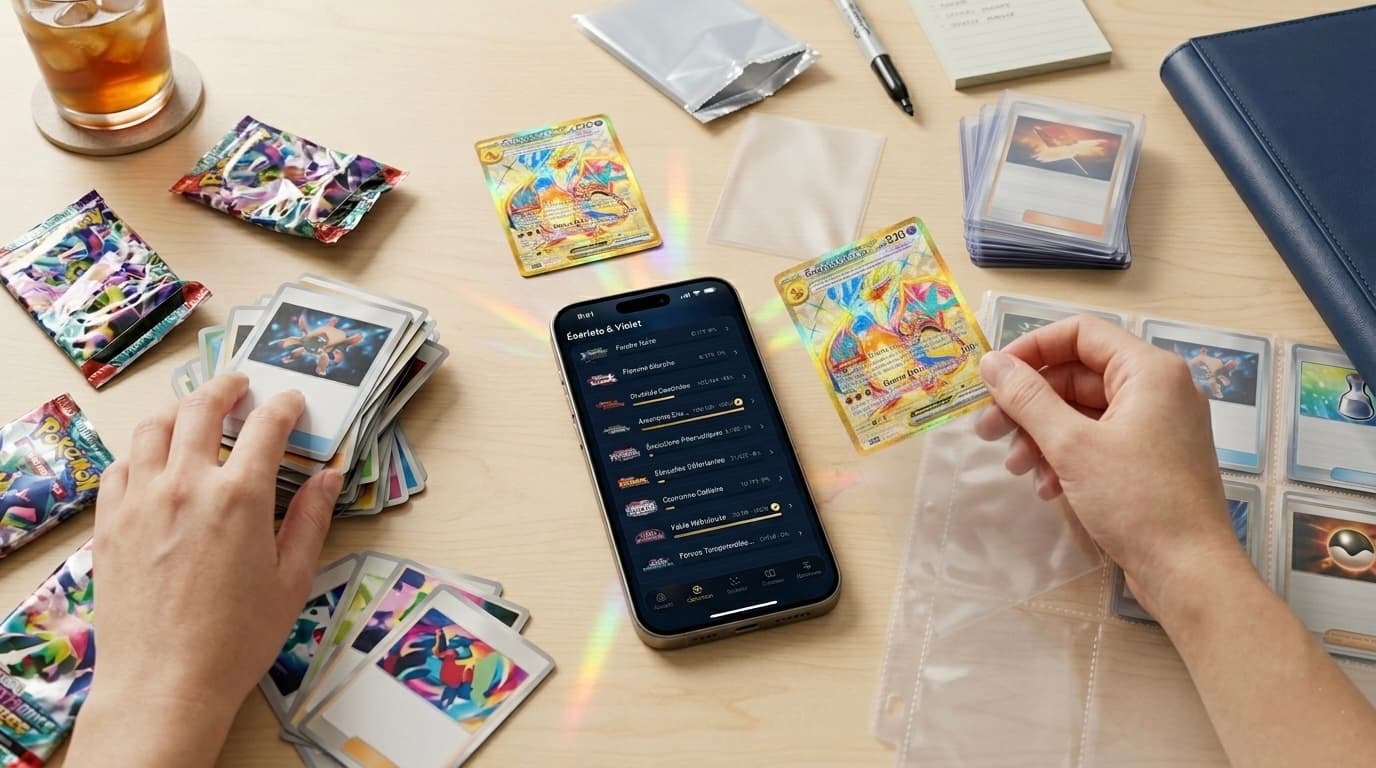
Pokémon Card Collection on Mobile: Organizing and Valuing It in 2026
How to manage your Pokémon card collection on mobile in 2026: sort by set, track market values and estimate total worth with a dedicated app.
You have cards everywhere, in sleeves, shoe boxes, binders piled up in a corner, and one question that keeps coming back: "so how much is all this actually worth?" Managing your Pokémon card collection in an era where the physical TCG is booming is far more than a simple tidying hobby. It's real work of organization, market-value monitoring and strategic decision-making. And in 2026, the natural playing field for all of this is your smartphone.
The global collectibles market now exceeds 11 billion dollars, and the physical TCG segment alone accounts for 7 billion USD, with steady growth driven by collectors who are increasingly demanding about tracking their assets. In other words, an Excel spreadsheet just doesn't cut it anymore.
This article is a practical guide: how to structure your Pokémon card collection by set, by rarity and by value, why mobile has become the go-to tool, and what workflow to adopt so you never lose track again.
Why managing a Pokémon card collection has become a real challenge
A catalog that grows with every set
The pace of Pokémon TCG releases has accelerated considerably. In 2025-2026 alone, the new Mega Evolution block has rolled out sets at a sustained cadence: Phantasmal Flames (ME02, November 2025), Transcendent Heroes (ME2.5, January 2026), Perfect Balance (ME03, March 2026), and Ascending Chaos (ME04) expected in May 2026. Each set introduces new rarities, new card formats and new chase cards whose value can fluctuate rapidly.
Before that, the Scarlet & Violet block had already laid the groundwork for a complex collection with sets like Prismatic Evolutions (SV08.5, January 2025), a special series centered on Eevee's evolutions, which turned out to be one of the most sought-after of the cycle, with some cards reaching several hundred euros within the first few weeks.
The result: an "active" collection can easily hold several hundred cards from 5 to 10 different sets. Without a structured tool, it's chaos.
The three concrete problems of the ill-equipped collector
1. Invisible duplicates. Without precise tracking, you buy boosters and end up with the third copy of a card you already had. Frustrating and expensive.
2. Market values that move without you. A card you paid €15 for can be worth €60 three months later, or drop to €8. Without secondary-market tracking, you miss the right moments to complete your collection or reassess your priorities.
3. Total value, a mystery. Most collectors don't know precisely what their collection is worth. With the binder open, you could have anywhere from €500 to €5,000 of cards without knowing it. This opacity makes any decision difficult, whether it's insuring your cards, reselling them, or simply understanding your level of commitment.
How to actually organize your Pokémon card collection
Three fundamental structuring axes
Good organization rests on three complementary dimensions:
By set
This is the most natural and practical sorting method for a physical TCG collector. Grouping your cards by set (Prismatic Evolutions, Phantasmal Flames, Transcendent Heroes...) lets you immediately visualize your completion rate per set and identify the missing cards. It's also the sorting mode used by the most effective management tools.
By rarity
Within a single set, rarity levels vary enormously, from commons to Special Illustration Rares, by way of Full Arts, Golds and Alt Arts. Sorting by rarity lets you prioritize acquiring the most sought-after cards and build a realistic wishlist based on your budget.
By market value
This is the most strategic sort. Knowing the 10 most valuable cards in your collection gives you a clear view of what deserves reinforced protection (sleeves, toploaders, storage in a dry place) and what can stay in a standard binder. This sort is also essential before any trade or sale.
The mobile workflow: from opened booster to verified value
Here is the workflow that the most organized collectors adopt in 2026:
- Opening a booster → scan the card directly with your phone
- Automatic identification → the card is recognized, its set and rarity are confirmed
- Adding to the collection → the card is recorded with its condition (mint, near mint, played...)
- Checking the market value → the secondary-market price is displayed in real time
- Updating the total value → the collection portfolio automatically recalculates
- Wishlist → if it's a card you needed, it automatically drops off your search list
This workflow, which would take 30 minutes on Excel, is done in under 2 minutes on a good mobile app. This is where managing a Pokémon card collection truly makes sense on a smartphone.
PokeItem: an app designed for the serious collector
PokeItem is available everywhere: as a web app from your mobile browser, tablet or desktop, and as native iOS and Android apps since version 2 (June 2026). You start in the browser with a single URL, and find the same collection on your home screen if you prefer.
What it does concretely for your collection
PokeItem is designed for collectors of physical Pokémon TCG cards who want a clear, quantified view of their collection. Here are the key features:
| Feature | What it concretely gives you |
|---|---|
| Collection tracking | Organize by set, rarity, condition |
| Real-time market values | Data from the European secondary market |
| Card scanner | Identify a card by photo in seconds |
| Estimated total value | See the value of your entire collection |
| Wishlist | Keep a list of cards to acquire |
| Advanced filters | Sort by set, rarity, type, price |
| Complete catalog | Access to all referenced sets |
What sets PokeItem apart for the French-speaking market
Where other tools rely on price data from the American market (in USD), PokeItem integrates market values from the European secondary market, which is crucial for a French collector who buys and compares prices in euros. A card trading at 30 USD on TCGPlayer may sell at a very different price on the European market.
PokeItem is available on a freemium basis: most of the tracking features are available for free, with no mandatory sign-up to get started. The interface is mobile-first by design: responsive, fast, usable with one hand while you sort through a binder.
A concrete use case: you come back from a flea market with about twenty cards bought as a bundle. In 5 minutes on PokeItem, you scan each card, add them to your collection, get their current market value on the European market, and immediately know whether you got a good deal or not.
The other options on the market in 2026
There are several tools for managing your pokemon collection app, and each has its strengths. Here's a factual overview.
Pokecardex
Pokecardex is the historic French-speaking reference for tracking Pokémon TCG collections. The mobile app (available on Android and iOS) catalogs more than 63,000 cards covering international, Japanese and simplified Chinese sets. It offers a card scanner, management by condition and language, and displays prices from Cardmarket and TCGPlayer. The free version is solid; the Pokecardex Plus subscription (€3.99/month or €39.99/year) unlocks the unlimited scanner and custom binders.
Pokecardex especially excels in the richness of its catalog and the depth of per-card data (versions, illustrators, conditions). It also includes a fully offline function that's very handy for events.
Pokéllector
Pokéllector is a historic English-language tool, available on iOS and Android, geared toward set management and visualizing missing cards. Its interface lets you check off your cards set by set and view prices from several web sources. It's appreciated for its quick learning curve and its access without sign-up. It remains mainly focused on English and Japanese sets, with an English-language interface.
CardMarket and TCGPlayer
These two platforms are marketplaces (where you buy and sell cards), not collection apps in the strict sense. They are nonetheless essential references for secondary-market prices: CardMarket for the European market (prices in EUR), TCGPlayer for the American market (prices in USD). Many collectors consult them alongside their main management tool.
What sets a good collection app apart in 2026
The market for management tools has grown crowded. To choose the tool best suited to the way you collect, here are the criteria that really matter:
1. Do the market values reflect the market where you buy?
A price shown in USD on an American market can be misleading for a European collector. The relevance of price data depends directly on the reference market used. Favor a tool whose data corresponds to the market where you actually operate.
2. Is the scanner genuinely fast and accurate?
A scanner that takes 10 seconds to identify a card or confuses two versions of the same alternate art will quickly become unusable. The best tools in 2026 have high recognition rates, including on the new rarities of the Mega Evolution block.
3. Is the interface genuinely usable on mobile?
Many tools were designed for desktop and adapted (sometimes clumsily) to mobile. To organize pokemon cards in real life, standing in front of a binder, at a convention, sorting after a booster session, you need an interface designed touch-first, not a resized Excel spreadsheet.
4. Is the total value calculated in real time?
This is probably the most underrated feature. Knowing the value of your collection at any moment lets you make informed decisions: when to complete a set before prices rise, when to wait, which cards to protect first.
5. Is it compatible with the way you collect?
Some collectors aim to complete a set (100% of a set). Others chase only rare cards and alt arts. Still others build an investment portfolio. A good tool must adapt to these different approaches, via filters, statistics and customizable views.
Quick comparison table
| Criterion | PokeItem | Pokecardex | Pokéllector |
|---|---|---|---|
| French-language interface | ✅ | ✅ | ❌ (English) |
| EU market values | ✅ | ✅ (CardMarket) | Partial |
| Card scanner | ✅ | ✅ (Plus) | ✅ |
| Estimated total value | ✅ | ✅ | Partial |
| Web access (no install) | ✅ | ❌ (native app) | ❌ (native app) |
| Freemium | ✅ | ✅ | ✅ |
| Wishlist | ✅ | ✅ | ✅ |
Conclusion: your Pokémon card collection deserves a tool worthy of it
In 2026, managing a Pokémon collection without a dedicated tool means moving blindly through a market that shifts fast. Each new set in the Mega Evolution block redefines market values, creates new chase cards and adds complexity to the catalog. Your physical Pokémon card collection has value, financial, emotional, patrimonial, and it deserves to be tracked seriously.
Mobile has become the collector's natural companion: always in your pocket, always available, whether to scan a card received as a gift, check the value of an Alt Art before a trade, or simply see at a glance what your binder is worth this month.
If you're looking for a pokemon collection mobile app designed for the French-speaking market, with market-value data in euros, a built-in scanner and a clear view of your collection value, PokeItem is made for you.
Last updated: 24 August 2026
Back to blogAlso worth reading
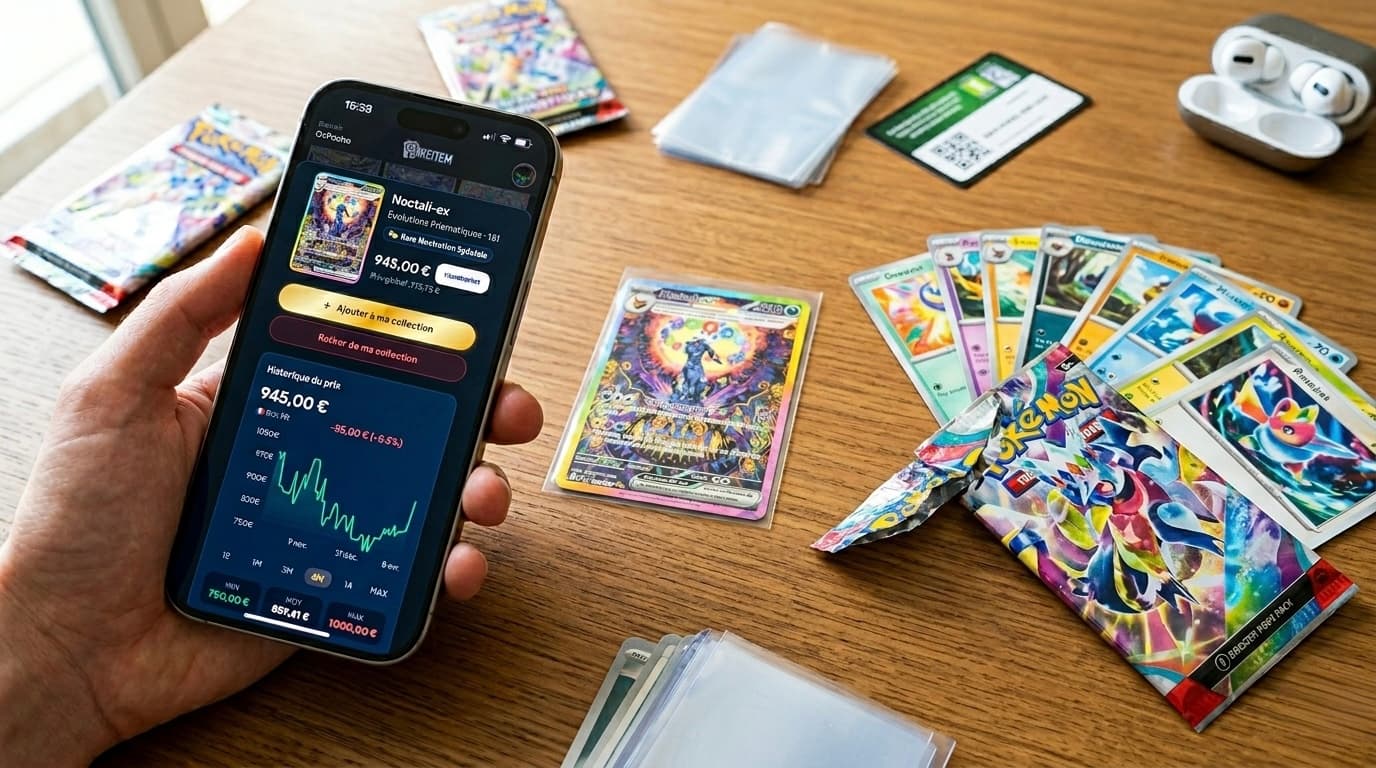
Track your cards' value day by day
Scan your cards, organise your collection and get price alerts, all on PokéItem.