
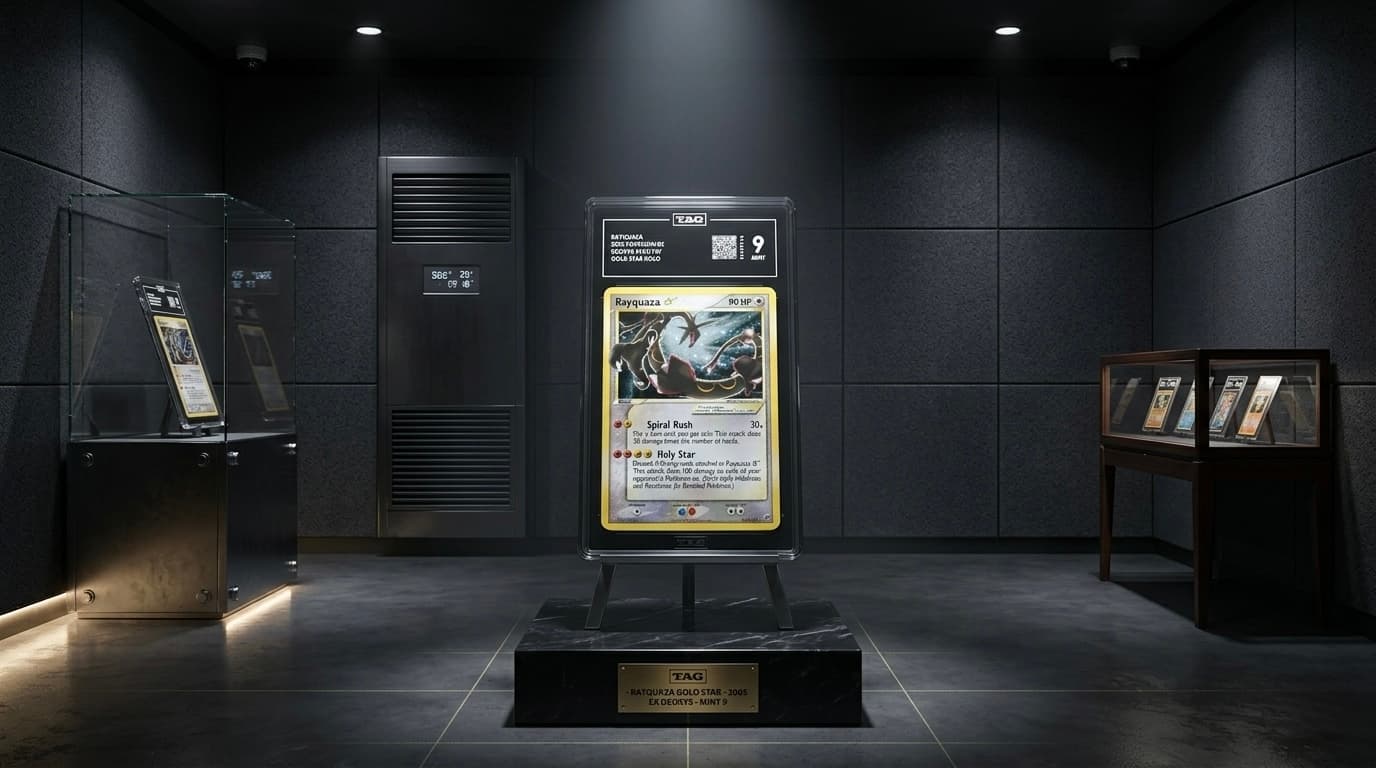
Rayquaza Gold Star EX Deoxys: Price and Market Value 2025
Rayquaza Gold Star price, raw and PSA 10 market value: everything about the 107/107 card from the EX Deoxys set, one of the most coveted of the vintage TCG.
If you're interested in valuable vintage Pokémon cards, the Rayquaza Gold Star price is one of the first searches that comes to mind. This card, numbered 107/107 in the EX Deoxys set, represents one of the absolute peaks of the physical TCG from the post-Wizards era. Gold, secret, illustrated with rare precision, it concentrates everything that makes a card desirable: an extreme print rarity, an iconic Pokémon and a pivotal era of the game. Whether you're a seasoned collector or simply curious to understand why some cards reach tens of thousands of euros, this article explains everything you need to know.
The EX Deoxys Set: Context
The EX Deoxys set was released in France in May 2005, at the same time as the North American release under the same English name (EX Deoxys). It belongs to the EX series, launched after Nintendo took back the Pokémon TCG rights from Wizards of the Coast in 2003. This period marks a major turning point: new mechanics, new designs, and above all the introduction of Gold Star cards, a subcategory of secret rarities recognizable by the gold star placed on the Pokémon's name.
EX Deoxys has 107 cards in its base set. The Rayquaza Gold Star card bears the number 107/107, which makes it a secret card, numbered exactly at the limit of the set, a convention that players and collectors of the era learned to decipher as a strong signal of extreme rarity.
The set is centered on Deoxys, the legendary Pokémon of Generation III, but ironically it's the Rayquaza Gold Star that established itself as the centerpiece of the set in the collective imagination.
The Card in Detail
- Number: 107/107
- Set: EX Deoxys
- Rarity: Gold Star (Secret Rare ★)
- Artist: Masakazu Fukuda
- FR release date: May 2005
Masakazu Fukuda's illustration places Rayquaza in a frontal posture, its long serpentine body unfurled against a predominantly dark background streaked with lightning and golden energy. The use of gold, typical of Gold Stars, isn't just a visual device: it immediately signals the card's exceptional status in the set's hierarchy. The artwork's rendering is dense, almost cinematic for its time, and stands out sharply from the set's standard illustrations.
The Gold Star finish also involves holographic treatment limited to the Pokémon's silhouette itself, which distinguishes it from classic holos where it's the background that shines. This technical detail is an important marker of authenticity when evaluating a copy.
Analysis of the Market Value and Current Prices
The Rayquaza Gold Star price varies significantly depending on the copy's condition. The market clearly splits between raw (ungraded) copies and PSA-graded copies.
Raw Price (Ungraded)
On the European market (Cardmarket notably), Near Mint copies start around €2,000, with recent sales observed around €3,900. Copies in very good but slightly played condition trade below this threshold, but remain rare to find.
On the American market, raw prices sit between $2,000 and $5,000 depending on the quality of the surface, corners and edges.
PSA 10 Price
This is where the figures become dizzying. Only ~47 copies have been graded PSA 10 to date, a figure that illustrates both the print rarity and the difficulty of obtaining a perfect copy after twenty years. Recent PSA 10 sales sit between $38,400 and ~$50,000, or roughly between €35,000 and €50,000.
Summary Table
| Condition | Estimated price |
|---|---|
| Raw (played / good condition) | €1,000 - €2,000 |
| Raw Near Mint (FR/EU) | €2,000 - €5,000 |
| Raw Near Mint (US) | $2,000 - $5,000 |
| PSA 9 | ~€10,000 - €20,000 |
| PSA 10 | €35,000 - €50,000 |
Data based on recent sales observed at the time of writing. Secondary market prices may evolve.
The Value Drivers
Several elements explain why the Rayquaza Gold Star's market value isn't weakening.
Print rarity. The pull rate of Gold Stars in the EX era is estimated at about 1 copy per 2 booster boxes. For a specific secret card in a set of this size, the odds of pulling it are extremely low, and twenty years later, finding sealed boxes is a feat.
Rayquaza's popularity. Among the legendary Pokémon of Generation III, Rayquaza holds a special place. Its design, its power in the video games of the era and its presence in the film Pokémon: Destiny Deoxys (released in 2004 in Japan, 2005 in France) gave it a lasting aura. This popularity translates directly onto the card market.
Definitive print status. The card has never been reprinted. Supply is structurally limited to the existing stock, which erodes over time (losses, destruction, poorly preserved copies).
Nostalgia and the post-Wizards era. The players who grew up with the EX sets between 2003 and 2007 are now reaching adulthood with the purchasing power to rebuild childhood collections, this phenomenon supports prices across all Gold Stars.
Very few PSA 10s available. With only ~47 perfect copies graded, each PSA 10 listing is an event on the market.
Should You Buy This Card?
Arguments For
The Rayquaza Gold Star is a card whose supply can only decrease over time. Its market value has risen steadily since the mid-2010s and the fundamentals (rarity, the Pokémon's popularity, absence of reprints) remain solid. For a collector seeking a reference vintage piece, it's a value hard to contest over the long term.
Points to Nuance
Accessibility is clearly the first barrier. Even a raw copy in average condition exceeds a thousand euros, and a Near Mint trades from €2,000. For a PSA 10, the entry ticket flirts with €40,000. This isn't a card to start out with in TCG investment.
Moreover, raw copies require heightened vigilance: fakes and restorations exist in this price segment. If you're considering a purchase, having the card appraised by a recognized grader (PSA, CGC, Beckett) before finalizing a high-priced raw transaction is an essential precaution.
Practical Tip
If your budget doesn't allow a Near Mint copy, a copy in good condition (slightly played) remains an entry into this market with real appreciation potential. For more wealth-oriented profiles, aiming directly for a PSA 9 or PSA 10 guarantees authenticity and liquidity in the event of a possible resale.
Conclusion
The Rayquaza Gold Star from the EX Deoxys set is much more than just another rare card: it's a piece that crystallizes an era of the Pokémon TCG and continues to attract buyers and collectors twenty years after its release. Whether you're seeking to understand its market value, add it to your collection or simply track how this market evolves, having a reliable tracking tool makes all the difference.
Follow its market value day to day on PokéItem, the web app for tracking prices and physical card collections, or download the app on your phone to have prices in real time wherever you are, whether you're on iOS or Android.
Last updated: 22 August 2026
Back to blogAlso worth reading


Track your cards' value day by day
Scan your cards, organise your collection and get price alerts, all on PokéItem.