
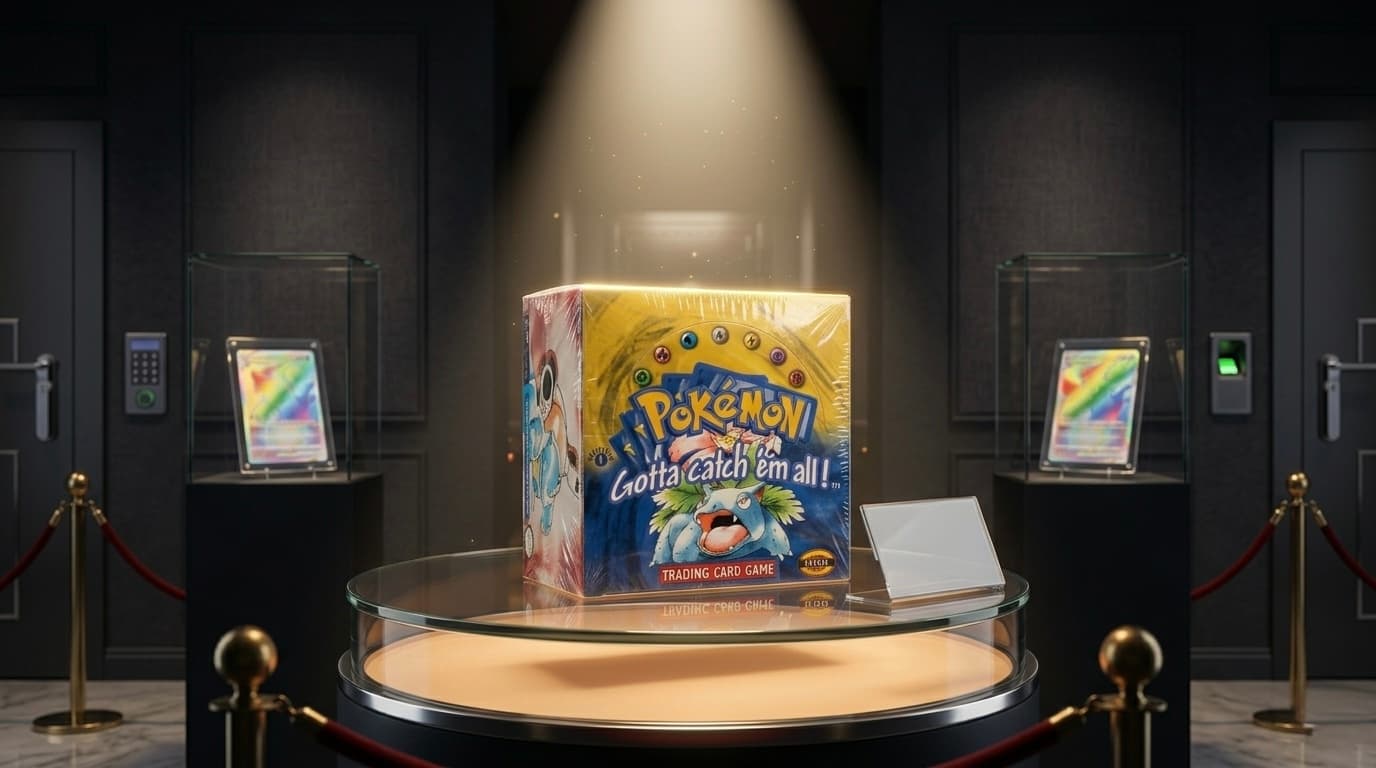
Sealed 1st Edition Pokémon box: why this value?
In 1999, a 1st Edition Base Set box cost a few dozen dollars. Today, it exceeds half a million. Here's why.
Sealed 1st Edition Pokémon box: why such a value today?
Picture a cardboard box, sitting in a warehouse somewhere in the United States in 1999. Inside: 36 boosters of Pokémon Base Set, English edition, first print. Back then, it was worth a few dozen dollars. Today, that same box, if it has stayed sealed, intact, preserved, can exceed 500,000 dollars at auction. The sealed 1st Edition Pokémon box value has become one of the most fascinating questions in the collecting world. But how did we get here? It's a story that blends nostalgia, absolute rarity and worldwide passion.
1998-1999: the birth of a global phenomenon
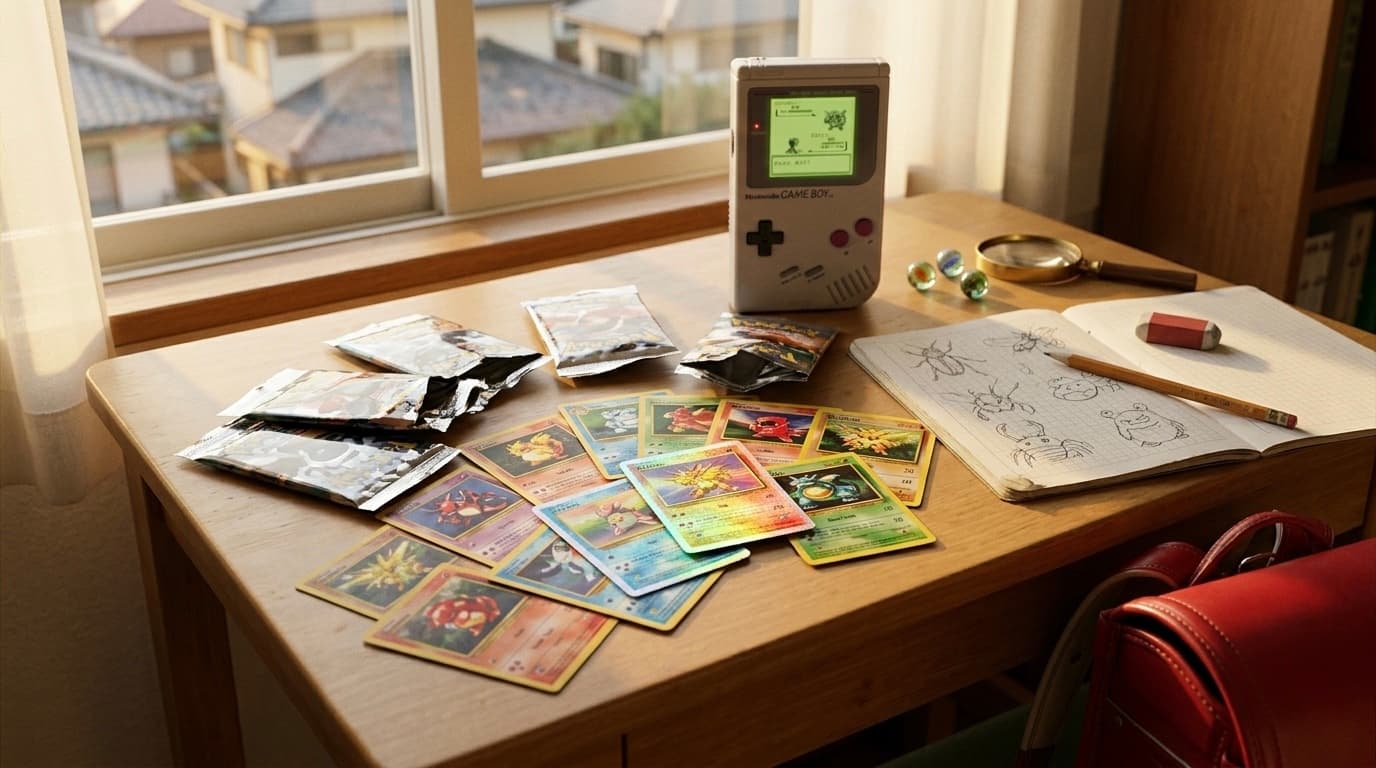
To understand the extraordinary value of these boxes, you have to go back to the beginning. Pokémon was born in Japan in 1996, first as a Game Boy video game. The franchise exploded quickly, and Wizards of the Coast, the American publisher behind Magic: The Gathering, obtained the license to produce the Pokémon card game in English.
The English Base Set was released in January 1999 in the United States. Demand was immediately phenomenal. Kids, parents, resellers rushed to the stores. The shelves were cleared out within hours. The frenzy was such that Wizards of the Coast couldn't keep up with the pace.
What many don't know is that the very first print of the Base Set, the one we now call 1st Edition, is identifiable by a small, discreet stamp: the "1st Edition" symbol on the left of each card's artwork, and the absence of a shadow beneath the image. This print preceded a second wave, known as "Shadowless," then a third with shadows, which makes up the bulk of the production.
The 1st Edition was therefore printed only once, in a limited quantity, before Wizards was overwhelmed by demand and reprinted massively without this stamp.
Why did so few boxes survive?
This is where the story gets even more interesting. In 1999, almost no one imagined these cards would ever be worth anything. Sealed boxes were opened. Boosters were torn open by kids impatient to find their holographic Charizard or Mewtwo. Nobody kept a box closed with the idea of reselling it 25 years later.
Those who kept sealed boxes often did so by chance: a reseller who didn't move his stock, an individual who forgot a box in an attic, a visionary collector who sensed something. These cases are rare. Extremely rare.
Over the decades, natural degradation also takes its toll. The cardboard warps, the boosters yellow, the seals deteriorate. A box in perfect condition, with its original shrink-wrap intact and no warping, is nothing short of a miracle today.
The major sales that made history
For a long time, these boxes circulated quietly among passionate collectors. It was the wave of Pokémon TCG popularity during the 2020-2021 period, amplified by YouTubers like Logan Paul or Leonhart who opened vintage products live, that propelled these objects into another media and financial dimension.
In 2021, PWCC Marketplace and Heritage Auctions organized several sales of sealed Base Set 1st Edition boxes that reached record prices. Boxes in near-perfect condition, authenticated and graded by companies like BGS (Beckett) or submitted for specialized appraisal, were sold for more than 400,000 dollars. Some estimates for copies in exceptional condition mention the 500,000-dollar mark (to be verified according to the most recent sales).
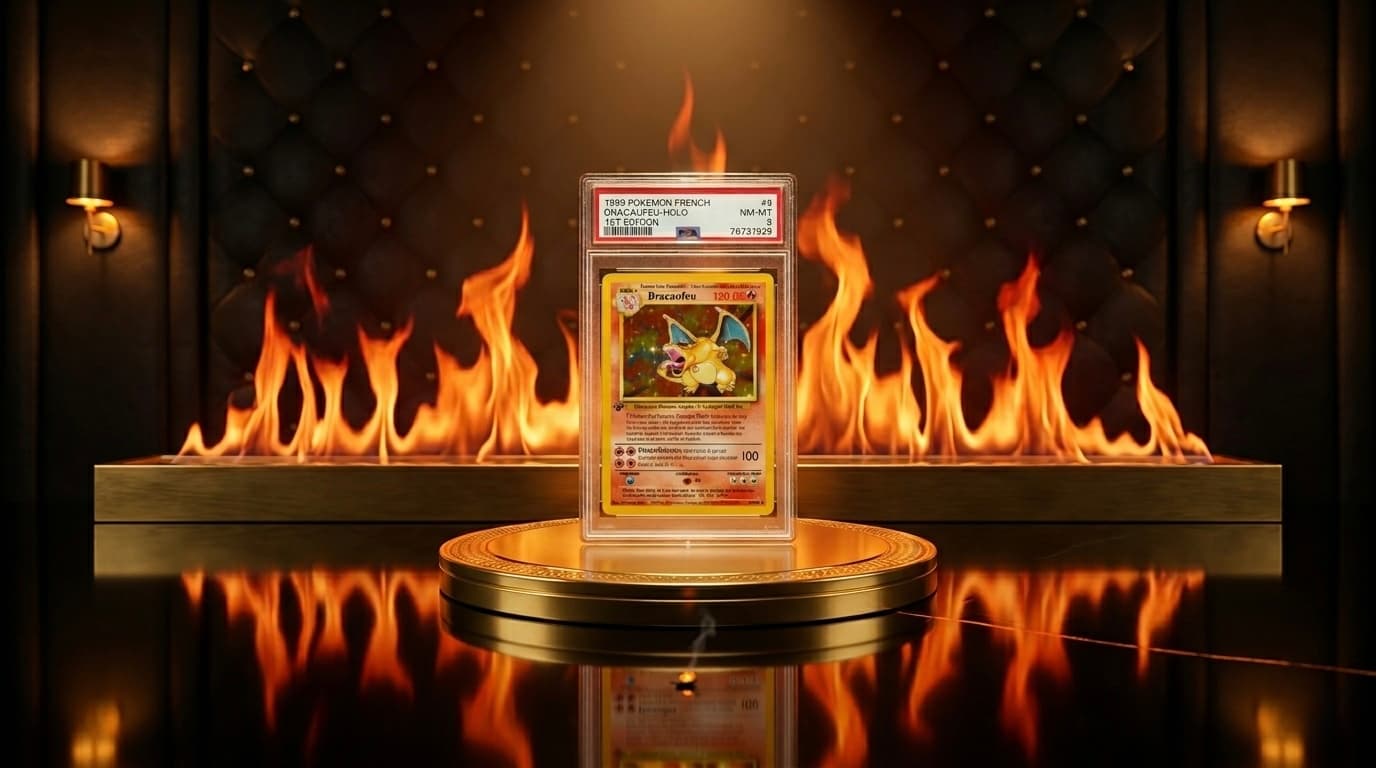
For a point of comparison: a 1st Edition holographic Charizard PSA 10, the most iconic card of this same set, sold for 216,000 dollars in December 2020 at an Iconic Auctions sale. A single card. A box contains 36 boosters, meaning a one-in-36 chance of pulling a Charizard, with no guarantee of quality.
The sealed 1st Edition Pokémon box value therefore isn't just the sum of its potential cards. It's worth something for what it represents: an intact object, frozen in time, that hasn't moved since 1999.
What creates the value: rarity, authenticity, nostalgia
A mathematical rarity
You can't print a new 1st Edition box. Wizards of the Coast lost the Pokémon license in 2003, to The Pokémon Company International. This 1999 print is permanently closed. Every box that disappears, opened, damaged, lost, shrinks an already minuscule stock a little more.
The weight of authenticity
In a market where counterfeits exist, authenticity is paramount. Serious buyers call on experts to verify the original shrink-wrap, the dating stamps, the texture of the cardboard, the alignment of the boosters inside. Some certification companies have developed specific protocols for sealed vintage products.
Nostalgia as fuel
The generation that grew up with Pokémon in the 1990s and 2000s is now in its thirties and forties. Many have disposable income and a desire to reclaim a fragment of their childhood. These boxes aren't just financial collectibles, they're time capsules. They smell of the 1990s, they embody an era.
A Grail that will never become common
Unlike other Pokémon products whose prices can fluctuate with reprints or market trends, a sealed Base Set 1st Edition box will never be reproduced. That's structurally impossible.
That's precisely what sets it apart from any other product in the Pokémon TCG universe. You can debate the value of a modern box, anticipate a set, wait for a promo. Here, there's nothing to wait for. What exists exists. And what disappears won't come back.
The sealed 1st Edition Pokémon box value is, in many respects, the trading-card-world equivalent of what an original manuscript is in the literary world: unique, irreplaceable, laden with history.
Conclusion
In 1999, no one kept a closed Pokémon box thinking about the future. That's precisely why the rare copies that survived intact are worth what they're worth today. The story of the 1st Edition Base Set is that of a bygone era, captured in cardboard and plastic, that the whole world is fighting over.
You may not own a sealed 1999 box, very few people do. But if you collect Pokémon cards, even modern ones, their value deserves to be tracked carefully. PokeItem lets you monitor the value of your cards in real time, so you never miss an important market move.
Last updated: 19 July 2026
Back to blogAlso worth reading
Track your cards' value day by day
Scan your cards, organise your collection and get price alerts, all on PokéItem.