
How the Pokémon TCG was invented in 1996: the complete story
In October 1996, Media Factory made a bold bet: adapting Pokémon into a card game. A look back at the birth of a global phenomenon.
How the Pokémon TCG was invented in 1996: the complete story
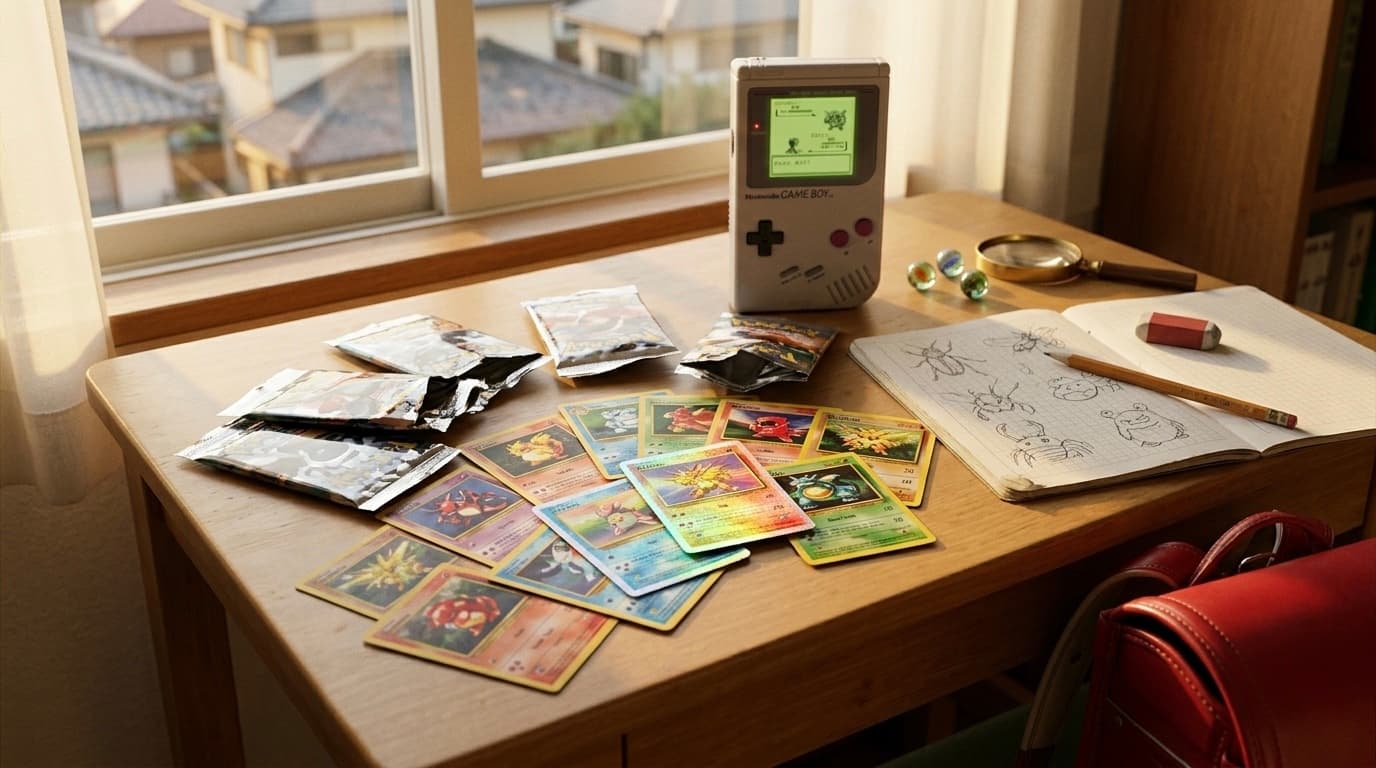
October 1996. In Japan, Pokémon was only a few months old. The video game released in February on Game Boy was a hit with children, but no one yet grasped the scale of what was being built. It's in this context that the history of the Pokémon TCG begins, and its creation in 1996 represents one of the boldest, and most successful, bets in the history of the trading card game. Here's a look back at the origins of a phenomenon that would change the TCG world forever.
A risky bet: adapting a video game into cards
The Pokémon franchise in 1996
When Satoshi Tajiri and Game Freak launched Pocket Monsters Red and Green in February 1996 on Game Boy, success came quickly in Japan, but it was still contained. The franchise drew the attention of several merchandise publishers, but adapting Pokémon into a trading card game was another matter entirely. At the time, the TCG was a market dominated by Magic: The Gathering, launched in 1993 by Wizards of the Coast. Transposing a video game universe into a TCG was an unprecedented idea at that scale.
It was Media Factory, a subsidiary of ASCII Corporation specializing in manga and gaming merchandise, that seized the opportunity. The company obtained a license from Nintendo and Game Freak to develop an official card game based on the Pokémon universe.
Koji Nishino, the architect of the game
The name Koji Nishino is inseparable from the birth of the Pokémon TCG. A game designer at Game Freak, he was tasked with overseeing the game's design and ensuring the game mechanics stayed consistent with the Pokémon universe. His role was crucial: he had to create a card game that was both simple enough for children and deep enough to keep players engaged over the long term.
The gameplay system that emerged from this work rests on accessible principles: each player builds a 60-card deck, puts Pokémon into play, evolves them and has them battle using Energy. The player who knocks out the opponent's six Pokémon first wins the game. This system, designed to be intuitive, would become the backbone of a game that still exists today.
October 1996: the launch in Japan
The first Japanese edition
On October 18, 1996, Media Factory put the very first Pokémon TCG series on sale in Japan, known as the Expansion Pack Base Set (or 第1弾拡張パック, "First Expansion Pack"). It contained 102 cards, including the illustrious Charizard, Blastoise and Venusaur in their holographic versions. The illustrations were entrusted to several artists, including Ken Sugimori, who had already drawn the Pokémon for the video game.
The reception was immediate and massive. Japanese children, already familiar with Pokémon through the video game, rushed to these cards to build their collections. The "gotta catch 'em all" concept transferred naturally to the physical world of cards. Within a few weeks, booster packs were scarce in stores.
A success that exceeded all forecasts
Media Factory quickly followed up with new sets. By December 1996, a Jungle series was already in the works. The phenomenon grew to a scale no one had anticipated: within a few months, the Pokémon TCG became one of the best-selling card games in Japan, alongside the video game and the anime that started in April 1997.
The synergy between these three media, video game, cartoon and card game, was arguably one of the keys to the success. Every new Pokémon seen in the anime sparked demand for its card. Every TCG set strengthened attachment to the video game's characters. The Pokémon ecosystem was being built across several dimensions simultaneously.
1998-1999: the conquest of the West with Wizards of the Coast
Wizards of the Coast enters the scene
Riding the Japanese success, Nintendo sought an American partner to take the Pokémon TCG global. The choice fell on Wizards of the Coast, the publisher of Magic: The Gathering and Dungeons & Dragons. The company, based in Renton, Washington, was at the time the world's benchmark for trading card games. It held the license to publish the Pokémon TCG in North America and in several Western countries.
In January 1999, Wizards of the Coast launched the English version of the Pokémon TCG in the United States, under the name Pokémon Trading Card Game Base Set. The cards were adapted, translated, and some illustrations slightly modified for the Western market. Booster packs were sold in big-box retailers, bookstores and game shops.
Pokémania takes over the West
The arrival of the TCG coincided with the launch of the Pokémon anime in the West (1998) and the release of the Pokémon Red and Blue video games outside Japan. The convergence was explosive. In the United States, schoolyards were flooded with Pokémon cards. Booster packs flew off the shelves, and rare cards like the holographic Charizard became objects of desire and intense trading.
In France, it was also in 1999 that the TCG made its official appearance, in a French version distributed by Wizards of the Coast. The same scenes played out in French schoolyards: children collected, traded, played, and sometimes fought over a rare holographic.
Wizards of the Coast managed the Western license for the Pokémon TCG until 2003, when Nintendo decided to bring publishing in-house by creating its own structure, The Pokémon Company International. But it was indeed thanks to Wizards that the TCG established itself as a global phenomenon in the West.
A legacy that has endured for nearly thirty years
The history of the Pokémon TCG and its creation in 1996 is the story of a visionary insight: transforming a video game universe into a physical, tangible experience meant to be shared. Media Factory, Koji Nishino and their teams laid the foundations of a gameplay system that, despite thousands of cards and numerous sets published since, remains faithful to its original principles.
Today, The Pokémon Company International regularly publishes new series. The cards from the first Japanese edition and the 1999 English Base Set have become prized collectibles, living witnesses to that extraordinary birth. Understanding where the Pokémon TCG comes from also helps you better appreciate the historical value of the cards you own.
Do you collect Pokémon cards and want to track their value over time? PokeItem lets you manage your collection and monitor your cards' market values in real time, from first editions to the most recent releases.
Last updated: 19 July 2026
Back to blogAlso worth reading
Track your cards' value day by day
Scan your cards, organise your collection and get price alerts, all on PokéItem.