
Pokémon Card Price Guide: Where to Find Reliable Prices in 2026
There is no official price guide for Pokémon cards. Find out how market prices are built and where to find reliable valuations in 2026.
You are looking for a reliable Pokémon card price guide, something like a TCG equivalent of a car valuation tool that would instantly show you the exact value of your card. Bad news: that does not exist. Good news: the Pokémon secondary market runs on solid, transparent and publicly accessible sources - as long as you know where to look and how to read the numbers.
In this article, we break down the concept of a price guide in the Pokémon TCG world, explain how a market price is built, and walk you through the references to check when you want a serious valuation for any card in your collection.
Why There Is No Official Price Guide for Pokémon Cards
In the car industry, dedicated valuation tools publish reference values built from millions of standardised transactions. The Pokémon TCG, on the other hand, runs on a fragmented, highly volatile global market made up of millions of unique references - every card exists in multiple conditions, multiple languages, multiple editions, graded or ungraded.
The Pokémon Company publishes no official valuation for the secondary market. Its role stops at production: between March 2025 and March 2026, the company printed 10 billion cards, the third consecutive year at that production level. But once cards are in circulation, their value depends entirely on supply and demand across secondary markets.
The result: there is no official Pokémon card valuation in the strict sense. What is commonly called a "Pokémon price guide" is actually an average built from real sales recorded on major trading platforms. And that is precisely where the most reliable data lives.
The TCG Market Context in 2026
Before looking up a price, you need to understand the environment you are operating in. The global TCG market is estimated at 8.4 billion USD in 2025, with growth expected toward 9.2 billion in 2026 - an annual increase of around 6.9%. Pokémon alone accounts for more than 12% of that global market, making it one of the most active TCGs in terms of transaction volume.
Since 2020, the Pokémon market went through a spectacular expansion phase driven by the pandemic, social media and renewed interest from adult collectors. In 2026, observers broadly agree on a healthy correction after four years of continuous growth. In practical terms: less short-term speculation, prices stabilising on modern cards, and a return to fundamentals for vintage cards.
For you as a collector or investor, this is the ideal moment to learn how to read prices correctly - because a misread valuation can cost you in both directions (buying too high or selling too low).
What Volatility Means for Prices
The same card can lose 30% of its value within a few weeks if a new set floods the market with reprints, or conversely spike sharply after a tournament or an official announcement. Asking prices from sellers do not always reflect actual transaction reality - which is why distinguishing listed prices from prices actually paid matters so much.
The Real Sources for a Reliable Pokémon Card Price Guide
Here are the platforms that serve as references for establishing a serious valuation on the secondary market.
| Source | Geographic zone | Currency | Available data | Seller fee |
|---|---|---|---|---|
| CardMarket | Europe (DE, FR, NL, ES, IT...) | EUR | Trends, recent sales | ~5% |
| eBay (sold listings) | Worldwide | USD/EUR | Completed sales | ~10% |
| TCGPlayer | United States | USD | US market prices in real time | Variable |
| PriceCharting | Worldwide | USD | Price history | Free |
CardMarket is the essential European reference. With an audience covering Germany, France, the Netherlands, Spain and Italy, it is the marketplace where the majority of TCG transactions in euros take place. To get a reliable price, check the "Trends" tab rather than the lowest listed price - the latter often corresponds to a card in poor condition or a seller liquidating at a loss.
eBay remains essential for rare cards and the vintage market. The key: filter by "Sold Items" (not "Items for Sale"). This filter shows only completed transactions, which eliminates the wishful pricing of uninformed sellers. For PSA or BGS graded cards, eBay is often the most representative source of real market value.
TCGPlayer is the reference in the United States and useful for tracking global trends, but its prices are in USD and do not account for the specifics of the European market.
PriceCharting offers a useful history for long-term analysis, but its update lag makes it less suited to immediate buying or selling decisions.
The Factors That Influence a Pokémon Card's Value
Understanding how a price is built means knowing which variables come into play. A Pokémon card price guide figure is never a fixed number - it is a range that depends on several cumulative criteria.
Card Condition: The Most Underestimated Factor
This is probably the variable that surprises new collectors the most. The value difference between a Near Mint (NM) card and a Moderately Played (MP) card can represent 50 to 70% of the price. In other words, a card estimated at 100 euros in NM may only be worth 30 to 50 euros in MP on the market.
The condition grades used on CardMarket:
- Mint (M) / Near Mint (NM): no visible defects, sharp edges, intact surface
- Excellent (EX): slight signs of wear, practically imperceptible
- Good (GD): visible wear but playable card, slightly blunted corners
- Light Played (LP) / Moderately Played (MP): scratches, damaged corners, possible creases
- Poor (P): heavily damaged, residual value only on very rare cards
Rarity and Card Type
The modern rarities from the Scarlet and Violet block - Illustration Rares (IR), Special Art Rares (SAR), Hyper Rares - have introduced a new value hierarchy. A SAR of a popular Pokemon like Charizard or Mewtwo can be worth several tens of euros, while the lower rarity version of the same card trades at a few euros.
For vintage cards, Base Set 1st Edition holofoils sit at the top of the pyramid. High-end PSA 10 cards such as the 1st Edition Base Set Charizard can reach estimated values between 300,000 and 400,000 USD according to specialist sources.
Language and Version
Japanese cards are often better preserved (more careful print runs, packaged in more protective boosters) and carry a specific premium on the graded card market. French cards, printed in smaller quantities than English or German on certain sets, can sometimes command a premium on the European market.
PSA, BGS and PCA Grading
More than 80% of cards sold above 500 euros are graded cards. A PSA, BGS or PCA certificate transforms a card into an asset whose condition is verified by a third party - which justifies a significant price premium. There are now more than 50 million PSA-certified cards in the world.
The Set and Print Run
A sold-out set with a low remaining print run will naturally see its prices rise. Conversely, a set still available in stores has not yet reached its post-production price floor. Tracking the release calendar and distributor stock levels is one of the habits worth developing to sharpen your Pokémon card price references.
How to Build Your Own Pokémon Card Price Guide
Here is the practical method for establishing a reliable valuation on a card before buying or selling.
Step 1 - CardMarket, Trends tab Search for your card on CardMarket. Ignore the lowest price - it often corresponds to the card in the worst condition. Check the Trend Price, which is calculated from recent sales. This is your first price anchor.
Step 2 - eBay, Sold Items filter Search the exact card name on eBay and apply the "Sold Items" filter. Look at the last 10 to 15 completed sales. Mentally calculate the median - not the average, which can be skewed by outliers. This is your second price anchor.
Step 3 - Cross-reference both sources If CardMarket and eBay converge within a close range, you have a solid market price. If the gap is significant (more than 25 to 30%), dig deeper: the difference may be explained by a graded card on eBay, a different edition, or a particular sales timing (announcement, tournament).
Step 4 - Adjust for condition Mentally apply a discount or premium based on the actual condition of your card compared to the cards in the listed sales. A NM card in a market where most sales involve EX cards will command a premium.
Practical Tips for Buying, Selling and Tracking Your Valuations
For buying: never rely on a private seller's asking price without checking recent sales. The lowest price is not always the best deal - an LP card at 15 euros is often less interesting than a NM copy at 25 euros if you are targeting resale or grading.
For selling: position yourself slightly below the CardMarket trend price if you want to sell quickly, or at the trend price if you can wait 2 to 4 weeks. On eBay, rare cards perform well at auction when their value exceeds 50 to 100 euros - competition between buyers can push the price above market.
For tracking your collection: keeping an up-to-date valuation on a large collection manually is tedious. This is exactly where a dedicated app like PokéItem makes sense - it centralises European market price data for every card in your collection, without you having to jump back and forth between platforms.
Watch out for seasonal bias: the Pokémon market follows cycles. Prices generally rise around the holiday season (November-December), during major set releases, and with every tournament announcement or official collaboration. Buying during quiet periods (January-February, summer) often offers better conditions.
On grading: submitting a card for grading has a cost (PSA fees, turnaround time, secure shipping). Calculate the ROI before committing - a card worth 30 euros in NM does not justify submission fees if the expected gain at PSA 10 does not exceed 60 euros. Grading becomes worthwhile above a certain value threshold, generally around 80 to 100 euros minimum for a modern card.
Conclusion
A Pokémon card price guide does not exist in the form of an official document - and that is ultimately a good thing. The Pokémon TCG secondary market is alive, transparent and documented in real time by millions of transactions on CardMarket and eBay. A reliable Pokémon card price is the one you build by cross-referencing those two sources with a clear method.
The real value of a card is the price at which it recently sold, in a comparable condition, to a motivated buyer. Everything else is speculation.
To stop doing this research manually card by card, PokéItem centralises European market price data directly inside your collection management interface. Whether you are on desktop or mobile, you can check the estimated value of each card, track how your collection evolves over time, and make informed buying or selling decisions. You can also download the app on your phone to have your Pokémon card price guide in your pocket at every flea market, convention or private sale.
Last updated: 30 July 2026
Back to blogAlso worth reading
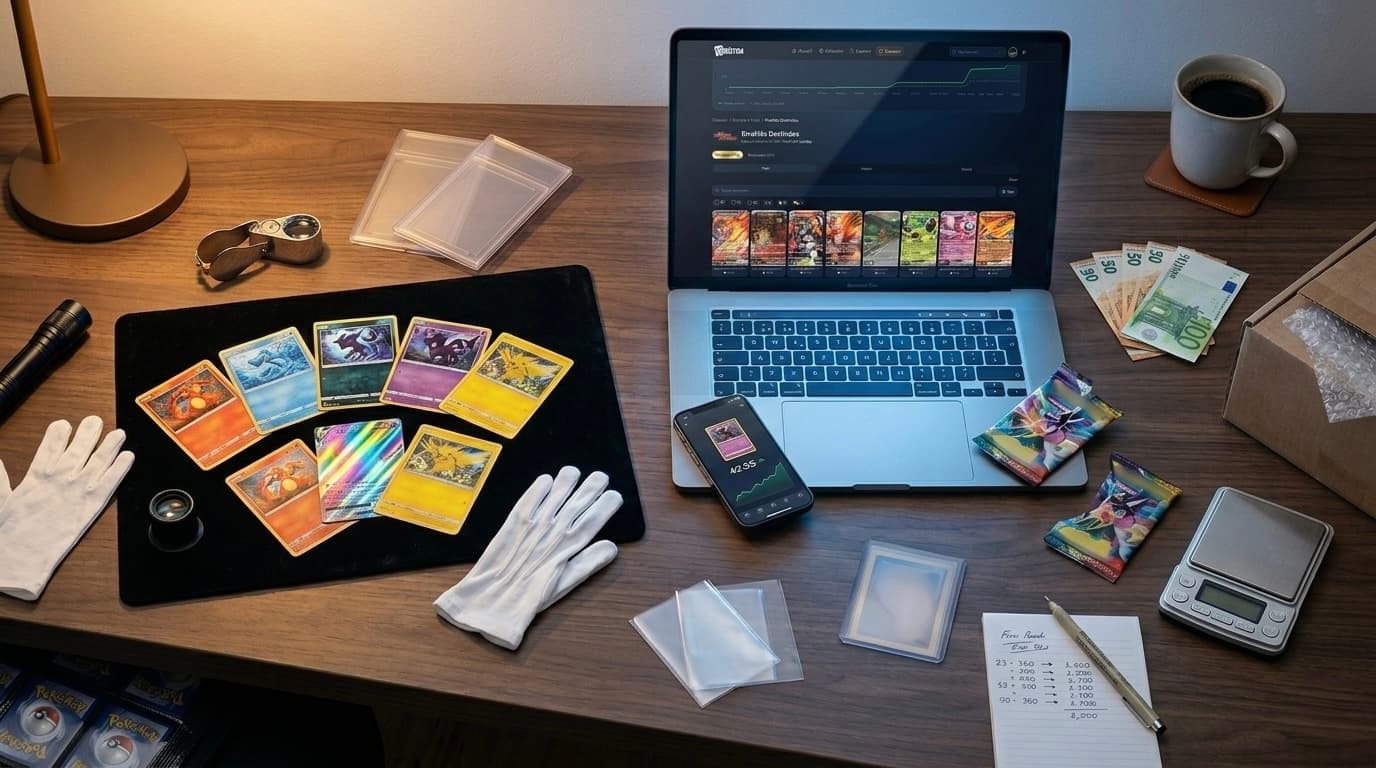
Track your cards' value in real time
Scan your cards, organise your collection and get price alerts, all on PokéItem.