
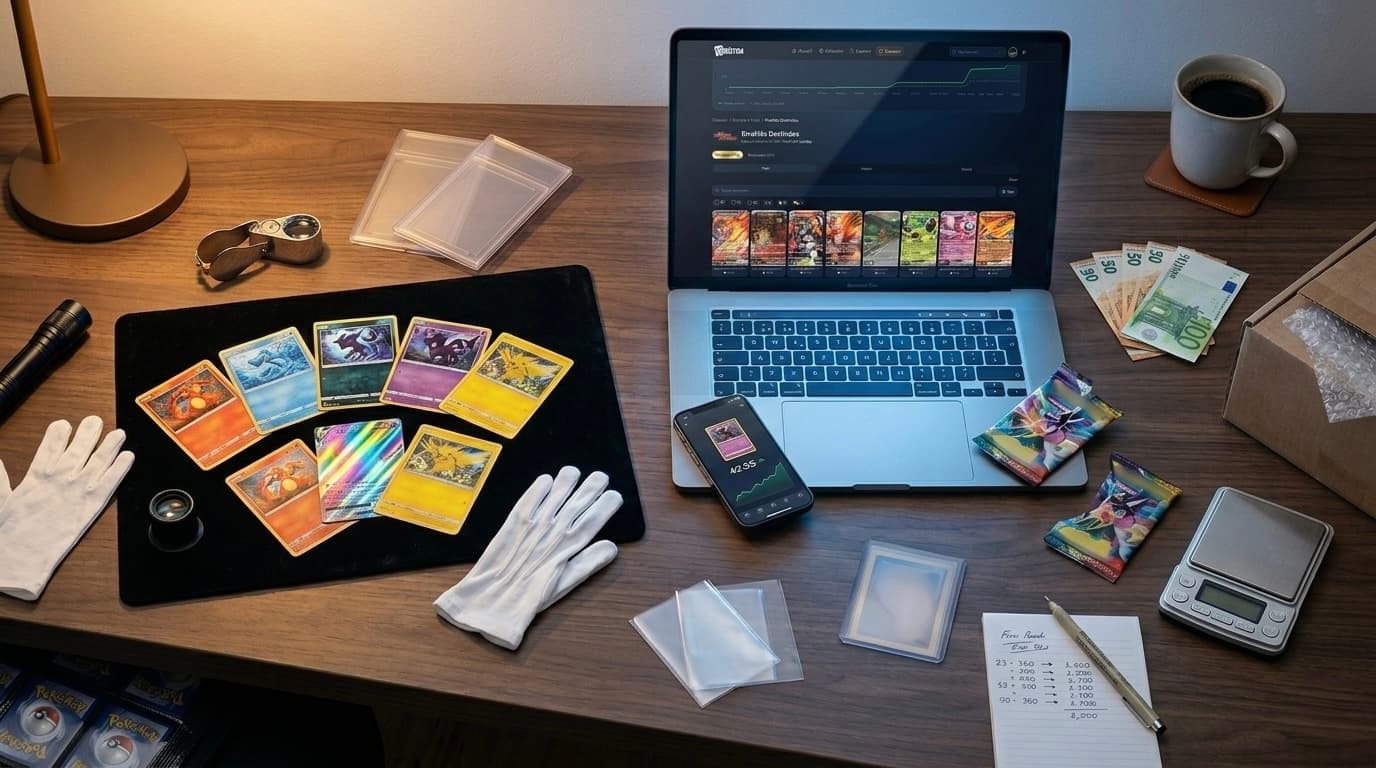
Pokémon Card Prices: How to Find Your Cards' Value in 2026
How do you find the price of a Pokémon card in 2026? A complete method: Cardmarket, eBay, PSA, value factors and tracking tools to estimate your collection.
The market for physical Pokémon cards has never been more active. In February 2026, the Pikachu Illustrator PSA 10 sold for $16.49 million at Goldin Auctions, an absolute record for a collectible card. At the other end of the spectrum, the Umbreon ex SIR from Prismatic Evolutions hovers between €800 and €900 raw, and an Umbreon VMAX Alt Art from Evolving Skies still trades at €1,200 to €1,500. Between these two extremes, thousands of Pokémon cards sleep in shoeboxes whose value nobody truly knows.
If you're wondering how much your Pokémon card is worth, you're far from the only one. This guide gives you a structured method and reliable sources to estimate the price of a Pokémon card rigorously, whether it's a vintage Charizard, an Illustration Rare from the Mega Evolution block or a common you simply want to assess before selling.
The Market Context: Why a Pokémon Card's Price Moves All the Time
You have to start from a simple reality: in the Pokémon TCG, there is no fixed price. A card's market value is entirely defined by supply and demand, and can vary by +50% in a few weeks following an event, a movie release, a video from a big content creator, the announcement of a reprint.
A Global Market, but a Distinct European Market
The Pokémon Company produced 9.7 billion cards in 2023, then 11.9 billion in fiscal year 2023-2024, a 22.68% increase in one year. This production volume has direct consequences on prices: modern common and uncommon cards have very little value, while chase cards (Illustration Rare, Special Art Rare, Hyper Rare) hold up well because they remain rare even in a heavily printed set.
On the European secondary market side, Cardmarket is the reference marketplace. The American market runs on TCGplayer instead, with prices in dollars that sometimes diverge significantly from the European market in euros.
2026: A Year Marked by the 30th Anniversary
The year 2026 marks 30 years of the Pokémon TCG, with the new Mega Evolution block that started as early as September 2025. The Journey Together (released January 30, 2026) and Prismatic Evolutions sets have already generated cards highly sought-after on the secondary market. In this context, tracking a Pokémon card's market value in real time is no longer a luxury, it's a necessity for any serious collector.
Table of Current Prices: A Few Market Benchmarks
Here's a table of benchmarks verified on the European secondary market (April 2026 data, sources Cardmarket and eBay completed sales). These prices are indicative ranges, the real value depends on the card's condition and language.
| Card | Set | Raw price (NM) | Estimated PSA 10 |
|---|---|---|---|
| Umbreon ex SIR | Prismatic Evolutions (SV8.5) | €800 - €900 | €2,800 - €3,800 |
| Umbreon VMAX Alt Art | Evolving Skies | €1,200 - €1,500 | €2,500 - €3,000 |
| Charizard ex IR | Obsidian Flames (SV3) | €200 - €400 | €800 - €1,500 |
| Mew ex IR | Pokémon 151 (SV3.5) | €150 - €300 | €600 - €1,200 |
| Rayquaza ex IR | Temporal Forces (SV5) | €100 - €250 | €500 - €1,000 |
| Charizard 1st Ed. PSA 10 | Base Set | , | ~$550,000 (Dec. 2025 record) |
| Modern rare holo card | SV / ME block | €2 - €20 | , |
| Modern Ultra Rare | SV / ME block | €20 - €100 | , |
| Secret Rare / Special Art Rare | SV / ME block | €100+ | variable |
⚠️ Reminder: these ranges reflect a trend at a given moment. The market fluctuates. Always check real completed sales before buying or selling.
How to Find the Real Price of a Pokémon Card
This is the key question: how do you find a Pokémon card's market value reliably, without being fooled by fanciful listings?
Step 1, Identify the Card Precisely
Before anything else, you need to know exactly which card you're holding:
- The card number (e.g., 161/131 for the Umbreon ex from Prismatic Evolutions): it gives you the set and indicates whether it's a secret card (number higher than the set total)
- The rarity symbol (bottom right): gold star = Illustration Rare, two gold stars = Special Art Rare, etc.
- The language: the same card can show very different prices depending on whether it's in French, English or Japanese
- The edition: a 1st edition (a "1" logo in a circle) is worth far more than an identical Unlimited version
Step 2, Check Cardmarket for the European Market
Cardmarket is the reference in Europe for checking Pokémon card prices. The platform aggregates thousands of offers from European sellers and displays continuously updated prices.
But beware of a classic pitfall: the prices displayed on Cardmarket are asking prices, not concluded sales. A card listed at €200 with no buyer isn't worth €200. To get a realistic estimate:
- Filter by language, condition (Near Mint preferably) and sellers in your geographic area
- Look at the price trend over 30 to 90 days rather than a one-off price
- Always cross-check with real sales
Step 3, Check Completed Sales on eBay
eBay is the other indispensable pillar to estimate the value of a Pokémon card. The trick: in the search filters, check "Sold items" and "Completed items" to show only finalized sales, what buyers actually paid, not what sellers hope for.
Enter the card name, the year, the condition and the details (holographic, alt art, graded or not) to refine the search. It's particularly useful for rare or graded cards, where prices can vary significantly from one transaction to the next.
Step 4, Use a Centralized Tracking Tool
Checking Cardmarket and eBay one by one for each card in your collection quickly becomes time-consuming if you have a few dozen or a few hundred cards. That's exactly what a tool like PokeItem was designed for: to centralize your collection's valuation in real time, without having to juggle several platforms.
The Factors That Influence a Pokémon Card's Price
Understanding what makes a Pokémon card valuable will help you better assess your cards and spot good opportunities.
1. Rarity
This is the first criterion. The rarity system was deeply overhauled with the Scarlet & Violet block (2023+), notably introducing:
- Illustration Rare (IR), gold star
- Ultra Rare (UR), two silver stars
- Special Art Rare (SAR / ISR), two gold stars
- Hyper Rare (HR), gold star with a black dot
Hyper Rare and Special Art Rare cards concentrate the bulk of a modern set's value. Commons and uncommons are generally worth a few cents, even in 1st edition.
2. Condition
Condition is often the decisive factor between two copies of the same card. A Near Mint (NM) card and a Lightly Played (LP) card of the same model can show a value gap ranging from x3 to x10. The standard scale:
- Mint (M): perfect, never played, flawless corners
- Near Mint (NM): slight marks on the edges, gloss intact
- Lightly Played (LP): small visible scratches, slightly worn edges
- Played (PL) and beyond: value in sharp decline
Be honest with yourself: we all tend to overestimate the condition of our own cards.
3. Language
The same card printed in different languages doesn't have the same price. English cards generally benefit from a more liquid international market and often sell slightly higher than French ones. Japanese cards obey their own market logic, sometimes cheaper, sometimes more, depending on the set.
4. Edition and Print Run
- A 1st edition card (a "1st Edition" logo) is systematically rarer and more expensive than an identical Unlimited version
- A reprint mechanically lowers the value of the original copies
- Some sets like Evolving Skies have never been reprinted, which sustains the rarity and market value of their cards (hence the very high prices of the Umbreon VMAX Alt Art)
5. The Pokémon's Popularity and the Market Context
Umbreon, Charizard, Mewtwo, Pikachu, Rayquaza, some Pokémon have such a fan base that their cards appreciate structurally more than others. Context also plays a role: an announcement of an animated adaptation, a major tournament, or simply a viral video can trigger a 30 to 50% rise on a card in a few days.
6. Grading
Having a card certified by a grading company profoundly changes its status on the market. PSA (Professional Sports Authenticator), founded in 1991, is the world leader and the reference that generates the strongest premium.
The PSA system assigns a grade from 1 to 10 based on four criteria: centering, corners, edges and surface. A PSA 10 (Gem Mint) can multiply a card's value by 5, 10 or even more. A concrete example: an ungraded Charizard GX Rainbow in excellent condition sells for around €40, versus €150 to €250 in PSA 10.
In terms of cost, going through an official PSA dealer in France costs around €30 for cards worth less than €300, and up to €105 for those worth between €1,500 and €2,500. The standard turnaround is about 95 business days. Other players exist: BGS (Beckett) for cards with perfect centering, PCA for French collectors, Pure Grading with shorter turnarounds (15 to 25 days).
Practical rule: only grade cards whose potential value in PSA 10 justifies the grading cost, generally, a card worth at least €50 to €100 raw before certification.
Practical Tips: Buying, Selling and Tracking Your Collection
The Right Time to Buy or Sell
- 2 to 3 months after a set's release: the hype peak subsides, prices stabilize, this is often the best time to buy a chase card at a reasonable price
- During reprint periods: the prices of the affected cards temporarily drop
- Avoid December: prices are inflated by Christmas demand
- On eBay, filter only on completed sales, active listings don't represent the real market
Protect Your Cards to Preserve Their Value
A card that loses condition loses value, sometimes massively. The basic reflexes:
- Sleeve (protective pocket) as soon as you open the booster
- Toploader or semi-rigid holder for valuable cards
- Binder or storage box away from humidity and direct light
- Never handle rare pieces without a card protector
Don't Confuse Asking Price and Real Value
The most common pitfall: finding a listing at €300 on eBay for a card, and concluding it's worth €300. Completed sales tell a different story, the same card may have sold for €80 the week before. Only completed sales count to estimate real value.
Conclusion: Tracking Your Collection's Price Is the Foundation
Estimating the price of a Pokémon card can't be improvised. The method is clear: identify the card precisely (number, rarity, language, edition), check Cardmarket for the European market, cross-check with eBay completed sales, and factor in the structural elements, condition, grading, rarity, the Pokémon's popularity.
But the real challenge, when you have a collection of several hundred cards, is to maintain an up-to-date view of the total value. That's precisely what PokeItem does: a free collection tracking tool that centralizes your cards by set and by rarity, shows you the real-time valuation based on European secondary market data, and lets you filter by price, rarity or type in a few seconds.
Whether you want to know how much your Pokémon card is worth before selling it, or simply have a precise view of what your collection represents, start by scanning your cards on PokeItem, it's free, and you'll have your answer in a few minutes.
Last updated: 22 July 2026
Back to blogAlso worth reading
Track your cards' value day by day
Scan your cards, organise your collection and get price alerts, all on PokéItem.