
Pokémon TCG Pocket vs Physical TCG: The Real Differences
TCG Pocket or physical cards? Understand the real differences between the two worlds and why PokéItem is the tool built for physical collectors.
You have heard about Pokémon TCG Pocket and you are wondering whether it replaces your physical collection. Or maybe someone recommended an app "to manage your Pokémon cards" and now you are not sure whether you are both talking about the same thing. The confusion is common, and completely normal. These two worlds share similar names but work in radically different ways. In this guide we clear everything up: what Pokémon TCG Pocket actually is, what the physical TCG represents, why the two do not mix, and which approach suits your collector profile.
Pokémon TCG Pocket: A 100% Digital Mobile Game
Launched worldwide on October 30, 2024 on iOS and Android, Pokémon TCG Pocket is an official free-to-play mobile app published by The Pokémon Company and developed by Creatures Inc. and DeNA. The concept is straightforward: every day you open 2 free virtual booster packs, you build a collection of digital cards, and you battle other players in a simplified format.
A few numbers that illustrate its explosive success:
- More than 100 million downloads by February 2025
- $500 million in revenue reached in just 4 months
- $1.3 billion generated in its first year according to AppMagic
- Available in 150 countries
The app offers immersive cards with animated 3D effects, trading between friends (within certain limits), and an experience designed to be fast and accessible. It is a polished, official product clearly built to reach a wide audience, including people who had never encountered the physical TCG before.
But here is the crucial point: all TCG Pocket cards are exclusively digital. No printed version of these cards exists. You cannot hold them in your hand, slip them into a card sleeve, or sell them on Cardmarket.
Physical TCG: The Printed Card Market
The physical Pokémon TCG is what collectors have known since 1996: printed cards sold in booster packs, boxes, pre-built decks, in specialty stores and online. That is the market PokéItem tracks.
This market is far from declining. The Pokémon Company produced 10.2 billion cards in the 2024-2025 fiscal year alone, for a cumulative total exceeding 75 billion cards since launch. Recent sets reflect a release schedule that remains as busy as ever:
| Set | English Name | Release Date |
|---|---|---|
| EV08 | Surging Sparks | Nov. 8, 2024 |
| EV08.5 | Prismatic Evolutions | Jan. 17, 2025 |
| EV09 | Journey Together | Mar. 28, 2025 |
| EV10 | Destined Rivals | May 30, 2025 |
| EV10.5 | Black Bolt / White Flare | Jul. 18, 2025 |
On the vintage segment, the physical market is posting impressive records: a PSA 10 graded 1st Edition Charizard reached $550,000, and a Heritage Auctions sale closed at $5.27 million in December 2025. The physical market has been in a maturity phase since 2024-2025, with speculators having stepped back and leaving room for collectors with a longer-term commitment.
The 5 Core Differences Between TCG Pocket and Physical TCG
1. Digital vs Physical
This is the most obvious difference but also the most important one: a TCG Pocket card only exists inside the app. A physical card is a real object you can collect, protect, display and resell. There is no bridge between the two. A digital card cannot be printed, and a physical card cannot be imported into TCG Pocket.
2. Different Stats
Pokémon TCG Pocket cards have different stats (HP, attacks, energy costs) from the original physical cards. The digital cards are specifically designed for the app's simplified format. They are not interchangeable between the two worlds, whether from a tournament legality standpoint or a technical one.
3. Opposite Business Models
TCG Pocket is free to download with virtual booster packs offered every day. Revenue comes from optional in-app purchases (premium passes, cosmetics). The physical TCG runs on a model of selling tangible products: booster packs, Elite Trainer Boxes, collector sets. Prices then fluctuate on the secondary market based on supply and demand.
4. Collection Value
A rare physical card can be worth several hundred or even several thousand euros on the European secondary market (Cardmarket) or the American one (TCGPlayer). Its value is influenced by its condition, its PSA or BGS grade, its edition, and current demand. A digital card in TCG Pocket has no legal market value outside the app. It cannot be sold for real money.
5. The Collector Experience
In TCG Pocket, the experience revolves around gameplay and collecting within a closed ecosystem. In the physical TCG, the collector interacts with a global market, local game stores, tournament venues, and communities of passionate fans. The tactile, heritage and economic dimensions are radically different.
Can You Be Both a TCG Pocket Player and a Physical Collector?
Absolutely, and many Pokémon fans do both. TCG Pocket and the physical TCG meet different needs and complement each other rather than compete.
If you are new to the Pokémon TCG world, TCG Pocket is an excellent entry point: no upfront investment, a chance to learn the game mechanics, and access to a large library of animated cards. It is also a way to test whether the world appeals to you before diving into physical collecting.
If you are already a physical collector, TCG Pocket can be a fun side activity with no direct connection to your real card collection. The two hobbies do not compete with each other.
For the tcg pocket collector who genuinely wants to build a collection with lasting value, hold onto cards over the years, and track price movements on the market, the physical TCG remains the right playing field.
Why PokéItem Focuses Exclusively on the Physical TCG
This question comes up often: why does PokéItem not also manage TCG Pocket collections?
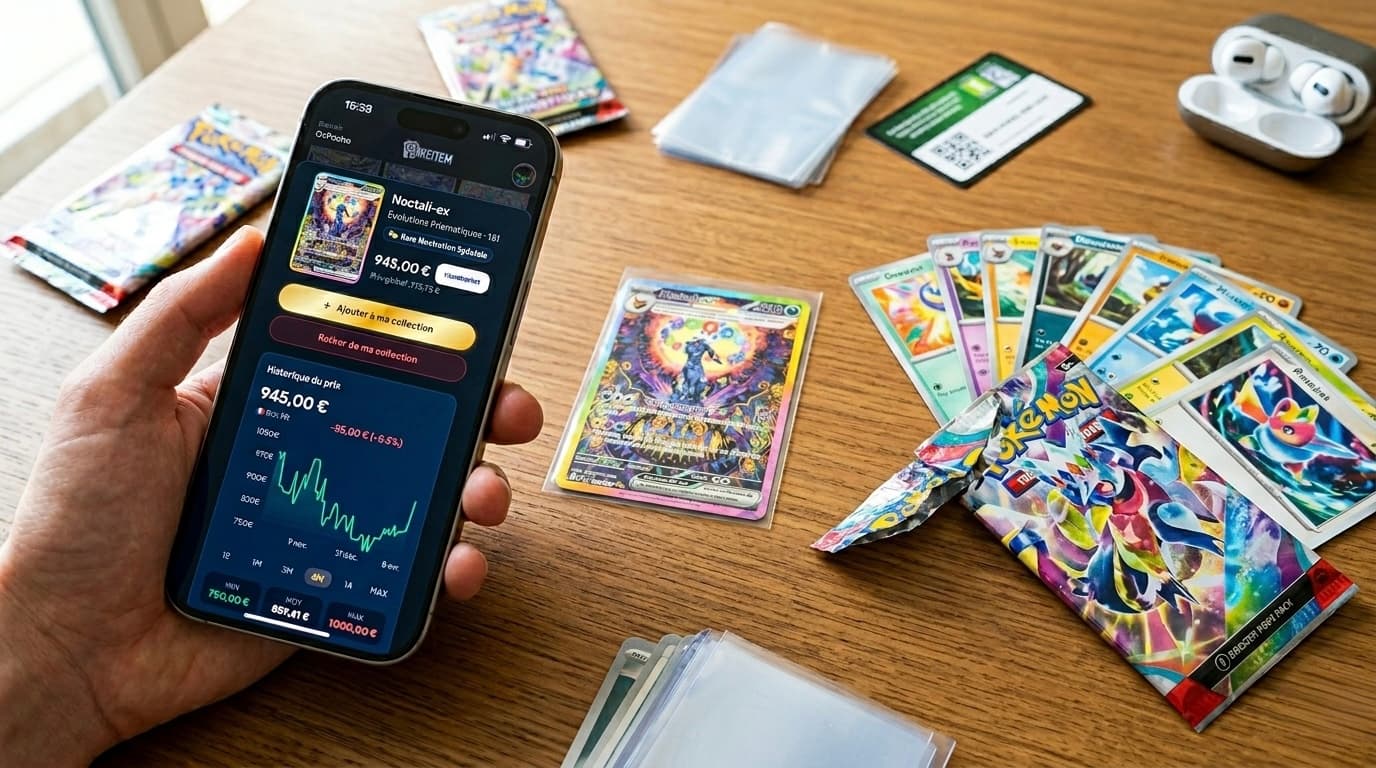
The answer is simple. PokéItem is a collection management tool built for serious collectors in the physical market. Its core value is real-time price tracking on the European secondary market, a feature that only makes sense for physical cards with real market value.
In practice, PokéItem lets you:
- Catalog your collection by set, rarity and condition
- Track the total value of your collection in real time
- Scan your cards to identify them quickly by photo
- Search the full catalog of every physical set
- Manage your wishlist of cards you are looking for
- Filter by set, rarity, type or price
For a digital pokemon tcg pocket collection, these features simply do not apply. The TCG Pocket app manages its own users' digital card inventories. The two tools are not meant to compete: they serve distinct needs.
Which Approach Fits Your Profile?
You Want to Play and Have Fun Without Spending Money
Start with Pokémon TCG Pocket. The app is free, the 2 daily booster packs are enough to gradually build a solid digital collection, and the simplified battle format is ideal for learning the mechanics. It is the best entry point for anyone discovering the Pokémon TCG world.
You Want to Collect Cards With Lasting Value
Head toward the physical TCG. Start with recent sets like Surging Sparks or Prismatic Evolutions to understand the current market, and use PokéItem to track the value of your acquisitions from day one. Getting into the habit of cataloging your collection right away saves a lot of regret later.
You Want to Invest in Pokémon Cards
The physical TCG is the only relevant ground for investment. TCG Pocket digital cards have no legal market value outside the app. On the physical side, the data is clear: the vintage market (PSA 10 graded cards from 1999 to 2002) is trending strongly upward, while the recent sets market follows a shorter-term demand logic. PokéItem gives you access to price data so you can make informed decisions.
You Are a Parent and Your Child Wants to "Play Pokémon Cards"
TCG Pocket is a safe and free option for a child who wants to discover the Pokémon world without you having to buy physical booster packs. If the enthusiasm sticks, the move toward the physical TCG will happen naturally, and PokéItem will be there to help you track the collection as it grows.
The Difference Between TCG Pocket and Physical TCG at a Glance
| Criteria | TCG Pocket | Physical TCG |
|---|---|---|
| Card type | 100% digital | Printed, tangible |
| Market value | None outside the app | Active secondary market |
| Cost to start | Free | Purchase of products |
| Trading | Limited (in-app) | Global market (Cardmarket, etc.) |
| Storage | Inside the app | Sleeves, binders, grading |
| Official tournaments | Pocket-specific format | Official TCG format |
| Tracking with PokéItem | No | Yes |
Conclusion
Pokémon TCG Pocket and the physical TCG are two official, complementary, but fundamentally different worlds. One is a digital mobile game where cards only exist inside the app. The other is a global market of printed cards with a 30-year history, auction records in the millions of dollars, and a passionate collector community.
If you are here, it is probably because the physical TCG appeals to you, or because you want to better understand what you already have in your hands. In that case, PokéItem is built for you: catalog your cards, track their prices in real time, and discover the true value of your collection. You can also download the app on your phone to scan your cards directly from your collection or at a card fair.
Both Pokémon TCG worlds are worth exploring, but with the right tools for each one.
Last updated: 31 August 2026
Back to blogAlso worth reading
Track your cards' value day by day
Scan your cards, organise your collection and get price alerts, all on PokéItem.