
Pokémon card price app: track your card value in real time
Which pokemon card price app should you choose in 2026 to track your collection's value? Complete guide: data sources, market tools and PokeItem.
You open a booster, you pull an Illustration Rare, and immediately you wonder: how much is this card worth today? That's the reflex of any serious collector. And in 2026, with a physical TCG market valued at $7 billion worldwide, the question is no longer trivial. A reliable pokemon card price app has become an essential tool, not a gadget. In this guide, we explain why value tracking is crucial this year, how market data works, and which tools come out on top for the European market.
Why price tracking became essential in 2026
The Pokémon TCG secondary market is no longer linear. Prices can swing by more than 50% within a few weeks following an event, a streamer video, an announcement from The Pokémon Company, or even a movie release. If you don't actively monitor your cards' value, you risk selling at the wrong time or missing a buying opportunity.
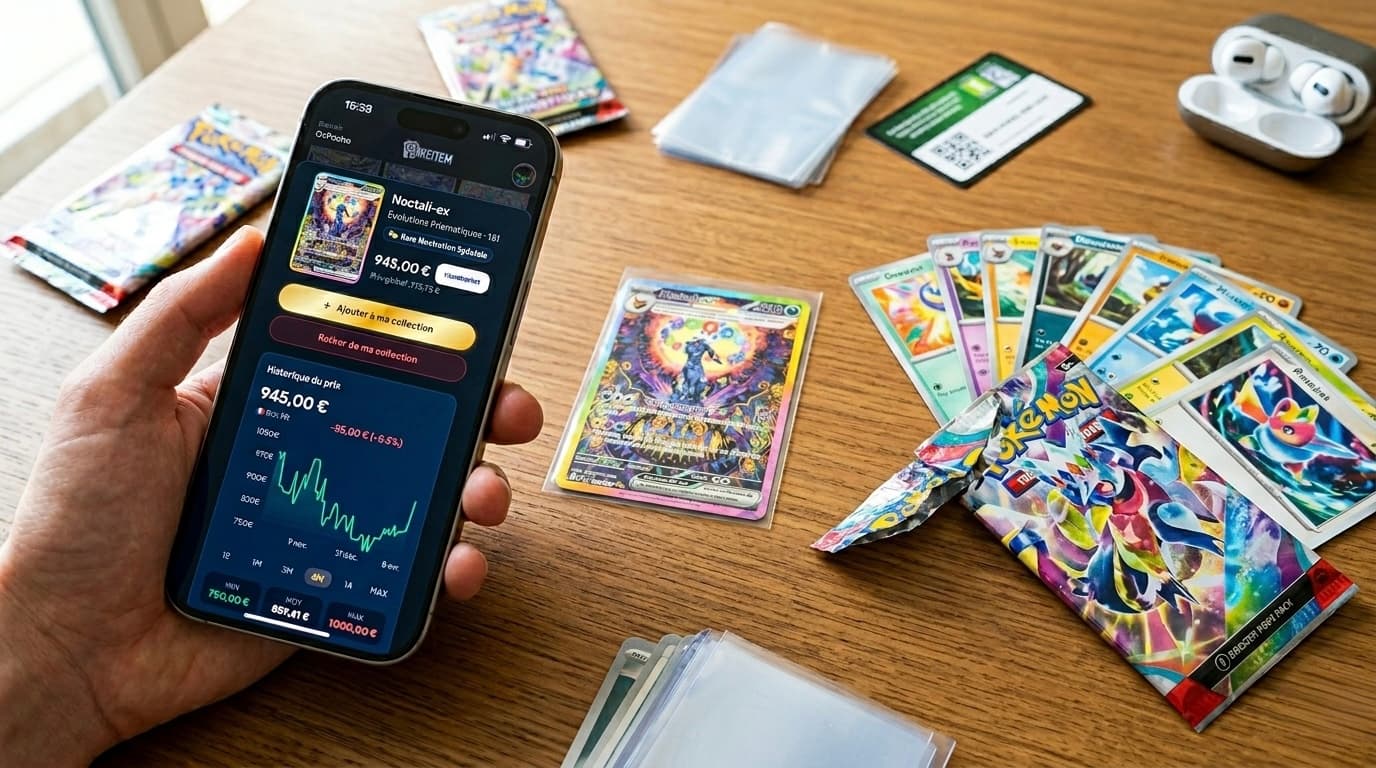
Take the concrete example of the Umbreon ex from Prismatic Evolutions (SV08.5, released January 2025): its raw price peaked around €1,400 in April 2025, before stabilizing between €800 and €900 in March 2026. A €600 swing on a single card, in less than a year. Without an active pokemon card tracker, it's impossible to react in time.
This volatility affects modern cards as much as vintage pieces. The Umbreon VMAX Alt Art (Evolving Skies) hovers around $2,259 in 2026, a card that didn't exist five years ago. And the market is drawing in more and more adult collectors: the 18-34 age group now represents 57% of TCG buyers.
In this context, real-time information isn't a luxury. It's the difference between a collection managed intelligently and a collection whose real value you discover… too late.
How price data works in the Pokémon TCG
Before choosing a pokemon card value app, you need to understand where the displayed data comes from. Not all apps are equal, and neither are all sources.
The two references of the secondary market
CardMarket is the largest European marketplace for buying and selling physical trading cards. It's the price reference for the French-speaking market and, more broadly, the European one, with transactions in euros. It's the primary source for estimating a card's real value in France.
TCGPlayer is the American equivalent: it displays prices in dollars and reflects US market demand. Useful for comparisons, but the prices can diverge significantly from those of the European market.
The trap of seller prices vs. real prices
A crucial point, often underestimated: CardMarket displays seller prices, not completed-sale prices. A card at €200 with no buyer isn't worth €200. For a reliable estimate, you need to cross-reference this data with sales actually completed, on eBay in particular, for rare or graded cards.
This is where the value of a good pokemon card price app comes in: it aggregates, filters and contextualizes this data to show you a relevant value, not just a price listing.
The factors that move prices
Several variables directly influence a card's market value:
- Rarity: an Illustration Rare (IR) or a Special Art Rare (SAR) doesn't follow the same curve as a standard Rare Holo
- Condition: Near Mint, Lightly Played, Damaged, each grade has its own market
- The set: a card from a non-reprinted set like Evolving Skies keeps its rarity over time
- Current events: a Pokémon featured in a video game, a movie or a Japanese set can see its value explode within days
- Language: French, English and Japanese cards don't sell at the same price on the European market
How PokeItem handles real-time price tracking
PokeItem (https://app.pokeitem.fr) is a physical Pokémon TCG collection management web app that natively integrates European secondary market value tracking. Concretely, here's what it changes in your daily routine.
Your collection's total value, at a glance
Every card you add to your collection is automatically valued according to current market data. PokeItem calculates in real time the estimated value of your entire collection, whether you have 50 cards or 5,000. It's a concrete indicator, directly usable if you're considering selling, insuring your collection, or simply knowing where you stand.
The scanner to identify and value instantly
PokeItem's card scanner lets you identify a card by photo, then immediately display its current value. You open a booster, you scan, you know. No need to search manually in a catalog or type the card number by hand.
Advanced filters to analyze your portfolio
PokeItem offers filters by set, rarity, type and price range. You can quickly isolate the highest-value cards in your collection, spot the most interesting sub-sets, or filter by condition to refine the estimate.
The wishlist coupled with prices
PokeItem's wishlist feature lets you track price movement on the cards you're looking to acquire, a real buyer-oriented pokemon card tracker, useful for buying at the right moment rather than at peak hype.
The other options on the market
There are several serious tools for pokemon card price tracking. Here's an honest overview of the alternatives.
Pokécardex
Pokécardex is the historical French-speaking reference for TCG collection management. Its mobile app (iOS & Android) lets you manage your collection in great detail: version, condition, quantity, language. It displays prices from CardMarket and TCGPlayer, with a catalog of more than 23,000 cards in the international version and more than 24,000 Japanese cards. Pokécardex is highly respected in the French-speaking community and also offers an active forum.
Worth noting: the platform uses the average of sales across all European languages combined, which can be a slight mismatch for collectors who specifically track French card prices.
CardMarket
CardMarket is both a data source and a marketplace. Its site offers built-in price-tracking tools, with the transaction history for each card. It's the absolute reference for completed sales in Europe. Its strong point: the granularity of the data (language, condition, seller). Its less practical side for collection tracking: you have to navigate card by card, without an overview of your portfolio.
TCGPlayer
TCGPlayer is the reference American marketplace, with a built-in collection tracking tool. Oriented toward the US market and prices in dollars, it's particularly relevant if you follow cards whose hype often comes from the United States or if you compare trends between the two markets.
PriceCharting
PriceCharting offers multi-license price tracking (video games, cards, consoles). For the Pokémon TCG, it provides a simple, readable price history, useful for a long-term view. It remains less precise than CardMarket for the European market day to day.
What sets a good Pokémon card price app apart in 2026
With the proliferation of tools, a few criteria help you sort through them.
1. The data source
An app that doesn't clearly state where its prices come from is an app to use with caution. The two solid references remain CardMarket for Europe and TCGPlayer for the US. Be wary of tools that aggregate data without indicating its freshness or origin.
2. Data granularity
A good tool must let you differentiate a Near Mint card from a Played one, a French version from an English one. Price gaps between conditions are real and significant, sometimes several dozen euros on the same rare card.
3. The consolidated collection view
Knowing the price of an isolated card isn't enough. Genuinely useful pokemon card price tracking calculates your collection's total value, segmented by set, rarity or type. That's what lets you identify the cards that carry weight in your portfolio and those sitting idle.
4. The mobile experience
In 2026, collection management often happens on mobile, at a card show, a convention, at a reseller's. A responsive app, fast to scan and readable in real conditions, is indispensable. A tool accessible only on desktop loses a lot of value in this context.
5. Keeping sets up to date
The pace of TCG releases is brisk. In 2025-2026, between Prismatic Evolutions (January 2025), Phantasmal Flames (November 2025), Transcendent Heroes (January 2026) and Perfect Balance (March 2026), each new set generates new cards and new prices to track. A good pokemon card tracker must integrate new sets within days of their official release.
6. Relevance for the European market
This is an often-neglected point: tools designed for the US market display prices in dollars, based on TCGPlayer. For a French-speaking collector, that's an approximation. Tools oriented toward CardMarket and the EU market display values more representative of what you can actually buy or sell in France.
Conclusion: market information is your best card
In 2026, a pokemon card price app is no longer optional for anyone who takes their collection seriously. Prices move fast, sets keep coming, and good buying or selling decisions are made with fresh data, not with a rough estimate six months old.
Whether you're looking to value your collection, spot the right moment to acquire a chase card, or simply know what your openings of the week are worth, the tool you use makes all the difference.
PokeItem offers precisely this kind of tracking, designed for the European market, with an interface accessible from any device. Since the v2 update, prices are now available by card condition (NM, Excellent, Good, Played, Poor) and the eBay market is integrated directly into each card page, which is a real game-changer for comparing before you buy or sell.
👉 Access PokeItem for free and start tracking your collection's value today.
Last updated: 19 July 2026
Back to blogAlso worth reading
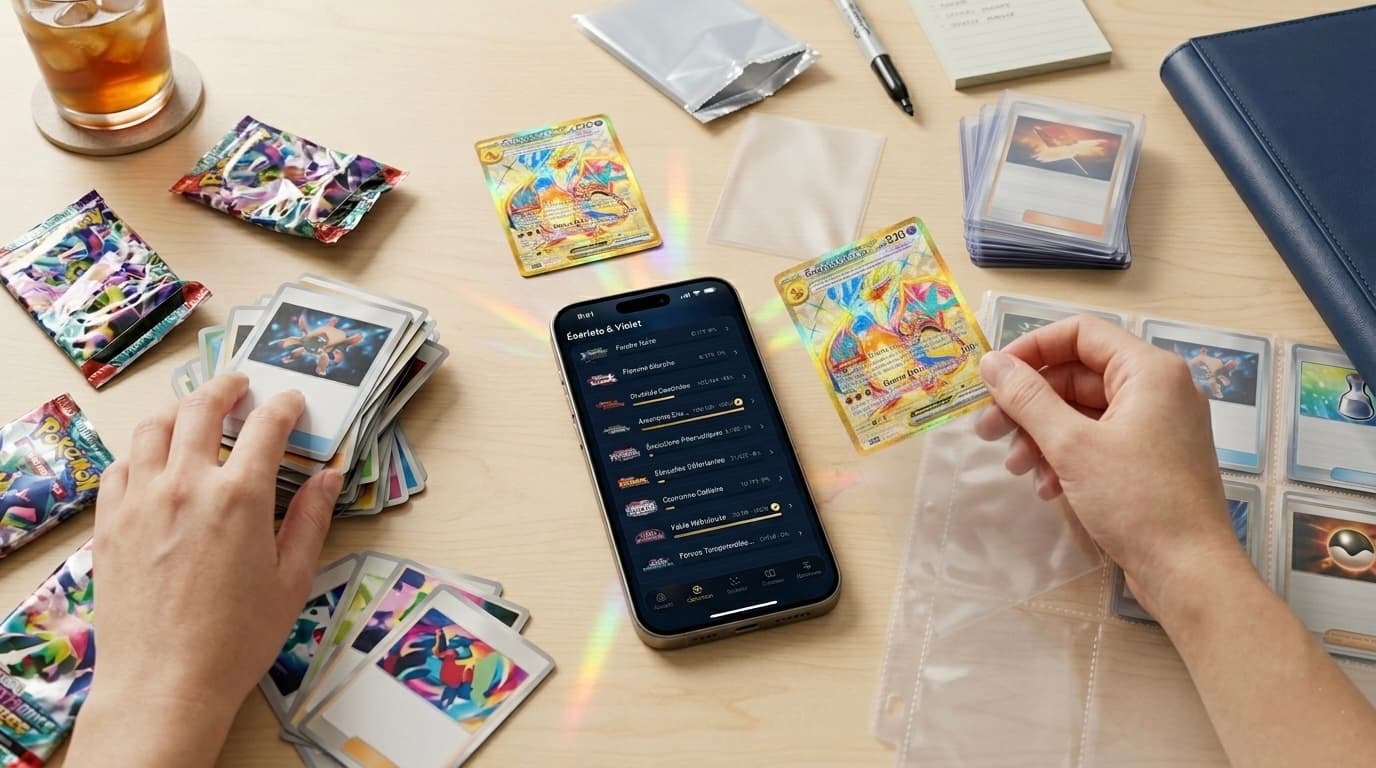
Track your cards' value day by day
Scan your cards, organise your collection and get price alerts, all on PokéItem.