
Trophy Pikachu, the rare tournament card: the story of trophy cards
Trophy Pikachu cards aren't bought in booster packs: they're won. A look back at the history of the most exclusive trophy cards in the Pokémon TCG.
Trophy Pikachu, the rare tournament card: the story of the most exclusive cards in the TCG
There are Pokémon cards that money simply can't buy, at least, not at the source. No booster pack to open, no box to hunt down in stores. The only legitimate way to get them is to win. To beat the best players in Japan, to stand on the top step of the podium at an official tournament organized by Nintendo or Game Freak, and to walk away with an envelope holding one of the rarest cards ever printed. The Trophy Pikachu rare tournament card is arguably the most iconic example of this category all its own in the history of the Pokémon TCG.
Cards born alongside the Japanese TCG
The story begins in Japan, in the early years of the Pokémon Trading Card Game. As early as 1997, Nintendo organized official tournaments across the country to promote the game and reward its best players. The idea was simple but powerful: give champions cards no other player could ever obtain any other way.
It was in this context that the first trophy cards were born. They belong to no official set, they're listed in no catalog. They exist solely to mark a victory, to immortalize a competitive moment.
The Trophy Pikachu: gold, silver and bronze
Among all these cards, the Trophy Pikachu hold a place apart. Handed out at the Japanese tournaments organized by Nintendo between 1997 and 1998, they exist in three versions matching the top three places on the podium: gold for first, silver for second, bronze for third.
Visually, these cards reuse Pikachu's classic design but with a gold, silver or bronze medal set into the artwork. The card carries no set number and no traditional rarity symbol. It's simply there, unlike anything that existed, or would ever exist.
What makes the Trophy Pikachu even more fascinating is the context of its creation. In 1997 - 1998, the Pokémon TCG was exploding in Japan. Tournaments drew hundreds of players. The kids who won these competitions walked away with cards whose historical significance they surely couldn't yet grasp.
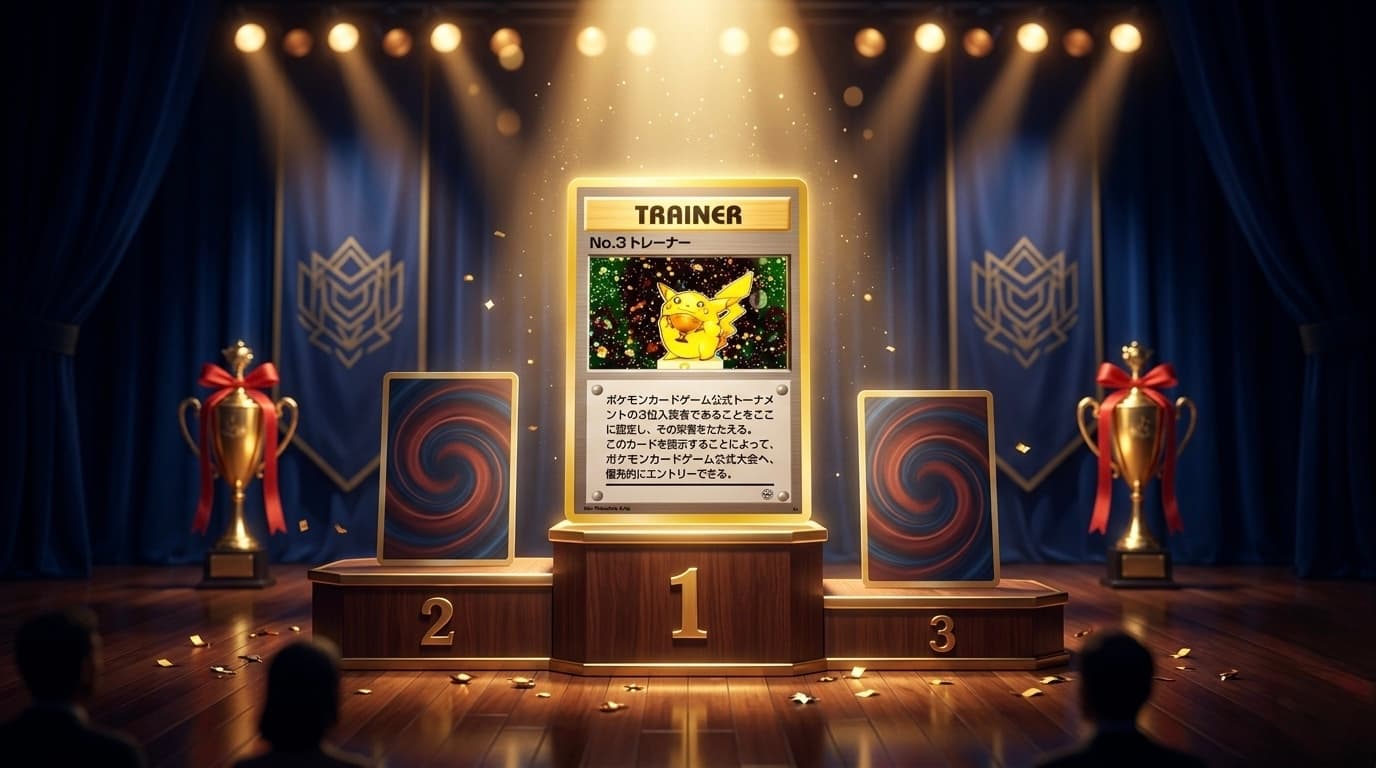
The No. 1 Trainer: the card for national-finals qualifiers
In the same period and the same spirit, other trophy cards came into being. The No. 1 Trainer, along with its No. 2 and No. 3 variants, was awarded to players who qualified for the Super Secret Battle, the Japanese national finals held in 1999.
The card depicts a Mewtwo and carries the inscription confirming that its holder qualified for the finals. It has no mechanical use in the game, it isn't playable in a deck. It's a certificate, a proof of performance, an object of absolute prestige.
The No. 1 Trainer is today considered one of the rarest Pokémon cards in the world. The exact number of copies distributed isn't established with certainty, but serious estimates put it at only a handful of examples, information to verify against the sources available at the time of reading.
An extraordinary secondary market
These trophy cards were obviously never meant to be resold. They were personal rewards, competitive keepsakes. Yet over time, and with the global explosion of interest in the Pokémon TCG, they've found their way onto the secondary market.
On the rare occasions a gold Trophy Pikachu or a No. 1 Trainer appears at auction, prices reach heights that few cards, even the most famous, can rival. These rare Trophy Pikachu tournament cards symbolize something money can't reproduce: a unique athletic performance, documented on cardboard.
Why these cards fascinate us so much
The fascination with trophy cards goes beyond their financial value. They tell a story. Every surviving example belonged to someone who won something. Someone who got up one morning, made the trip to a tournament hall somewhere in Japan, played better than everyone else, and went home with a card no one else would have.
It's that human narrative that makes them so special. When a collector acquires a Trophy Pikachu today, they aren't just buying a rare card. They're buying a fragment of TCG history, the physical testimony of a victory more than twenty-five years old.
The legacy of trophy cards in the modern TCG
The spirit of trophy cards didn't disappear with the 1990s. The Pokémon World Championships still hands out exclusive cards to participants and champions, like the World Championships trophies or the Stamp cards distributed at official events.
But the originals, the Trophy Pikachu, the No. 1 Trainer, retain a mythical status. They belong to an era when the Pokémon TCG was inventing its own rules, when no one yet knew that these little rectangles of cardboard handed out to Japanese kids would one day become some of the most sought-after collectibles in the world.
These Trophy Pikachu trophy cards embody, better than any other object, the duality of the Pokémon TCG: a popular game accessible to everyone, and at the same time a universe of absolute rarities reserved for a select few.
Conclusion
The Trophy Pikachu and the trophy cards of the earliest Japanese tournaments represent the purest thing in Pokémon TCG culture: the earned reward, the one-of-a-kind object, the true story printed on cardboard. They aren't rare because production was capped for commercial reasons. They're rare because there's only ever one winner of each tournament.
If you collect Pokémon cards and want to follow how prices evolve, modern cards as much as historic pieces, PokeItem lets you track market prices and keep your collection up to date. Because even if you can't win a Trophy Pikachu, knowing what your cards are worth is already a good start.
Last updated: 22 July 2026
Back to blogAlso worth reading
Track your cards' value day by day
Scan your cards, organise your collection and get price alerts, all on PokéItem.