
1st Edition Pokémon card print variants: the story
Behind every 1st Edition card lies a story of printers, differences invisible to the naked eye, and treasure hunts for passionate collectors.
1st Edition Pokémon card print variants: a world apart
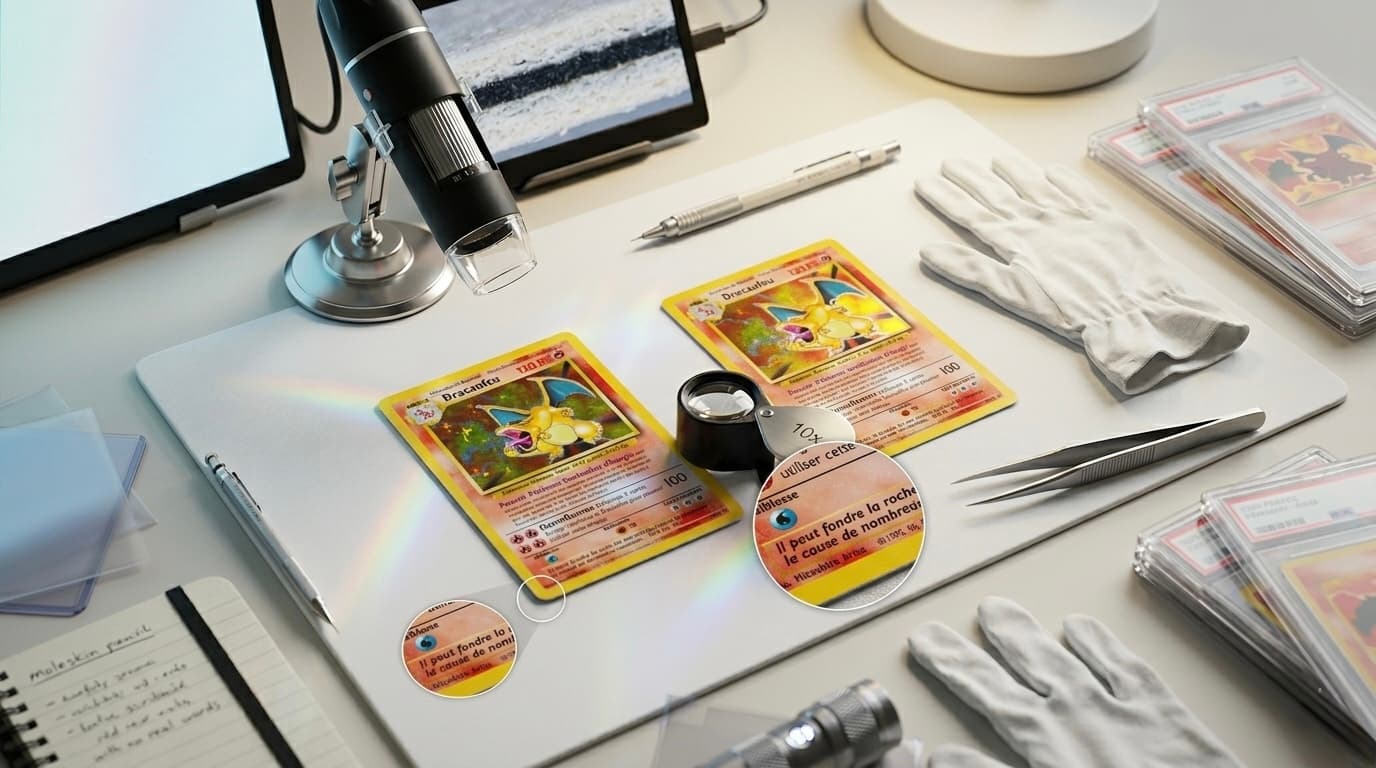
There's a category of collectors who aren't content just to hunt for a rare card. They hunt for the right version of that rare card. In the world of 1st Edition Pokémon card print variants, two visually identical copies can have radically different stories, and values. It all comes down to details the untrained eye will never spot. A shade of font. A slight difference in texture. A dot on a symbol. Welcome to one of the most fascinating rabbit holes in the Pokémon TCG.
1999: when Wizards of the Coast was printing at full speed
When the Pokémon Trading Card Game landed in the United States in January 1999, Wizards of the Coast (WOTC) faced a demand they simply hadn't anticipated. The Pokémon phenomenon was already global, and kids, and their parents, rushed to stores to get their hands on Base Set boosters.
To handle this colossal logistical pressure, WOTC didn't rely on a single printer. The cards were produced across multiple factories, at different times, with slightly different settings. That's where the first 1st Edition Pokémon card print variants were born.
The result: one and the same set, one and the same era, but cards that aren't quite identical depending on where they were manufactured.
The main families of 1st Edition Base Set variants
The "shadowless" variant and the 1st Edition stamp
Before getting into the details of the printers, you have to understand a fundamental distinction every collector knows: the difference between shadowless cards and shadowed cards.
The very first Base Set printings, the ones called shadowless, don't show a drop shadow beneath the card's artwork. This graphic detail was added in the following printings to give the design more depth. Among these shadowless cards, some carry the famous "Edition 1" stamp with the bullet symbol, that's the Holy Grail for collectors.
But within these shadowless 1st Edition cards, there are sub-variants tied to the printers.
WOTC Print 1 vs WOTC Print 2: the subtle differences
The collector community, notably on forums like PokeGym and Reddit, has documented over the years two main production variants for the WOTC 1st Edition cards.
The first variant, often referred to as "WOTC Print 1" or "1st print," is recognizable by certain typographic details. The font used for the hit points (HP) and the attack text shows slightly different characteristics. Some letters, like the "C" in "Copyright" or the style of the numbers, vary imperceptibly.
The second variant corrects or modifies some of these graphic elements. The most seasoned collectors can tell these versions apart thanks to the texture of the card's back, the color saturation, or the finish of the hologram on holographic cards.
Note: The exact naming of these variants ("WOTC 1," "WOTC 2"…) is used informally by the community. Official designations were never published by WOTC.
Paper and finish differences
Another element that distinguishes the variants concerns the physical stock itself. Cards produced in the earliest printings use a slightly different weight and cardboard composition than those of later printings. Under a magnifier, sometimes literally, some collectors examine the card's edge to observe the paper layers and their color.
The black inner layer visible on the edge of WOTC cards (often called the "black core") has become a reference point for authenticating vintage cards. But even among authentic cards, this layer can show slight variations depending on the production batch.
Why are some variants worth more?
The answer is, as so often in the TCG world, a mix of rarity and desirability.
The first printings of a set are naturally produced in more limited quantities. They correspond to the very first units put on the market, before the factories ramped up their pace. For a set as iconic as the 1st Edition Base Set, owning a card from the first wave of production adds an extra historical dimension.
Some variants are also more stable in terms of print quality. Collectors report that certain batches show centering problems more often than others, a key factor when you send a card off for grading at PSA, BGS or CGC.
Finally, there's collector psychology. Owning "the" oldest version, the one closest to the origin, has an emotional and symbolic value that the numbers don't fully capture.
How do collectors identify these variants?
This is where it gets really interesting. There's no official guide published by WOTC to distinguish these variants. All the knowledge has been built collectively, by thousands of collectors who compared their cards side by side, photographed details under a microscope, and shared their findings online.
The main resources remain:
- Archived threads on forums like PokeGym and reddit.com/r/pkmntcg
- Visual comparisons published by experienced graders
- Community databases like Bulbapedia for known printing errors
Some 1st Edition Pokémon card print variants are even documented as officially recognized errors. The most famous case remains the Charizard card, some copies of which show identifiable text or color anomalies, "error cards" that are the subject of a relentless hunt.
The impact of grading on variant visibility
The rise of professional grading services, PSA at the forefront, followed by BGS and CGC, has transformed the way these variants are perceived and traded.
When a card is encapsulated in a slab, the grader sometimes notes the variant on the label. PSA, for instance, has introduced sub-categories for certain cards to distinguish recognized variants. That label changes everything: it turns a technical distinction into official market value.
The same 1st Edition Charizard card can thus be given different labels depending on its production variant, and the market reacts accordingly.
A passion that doesn't stop at 1999
What makes this subject especially fascinating is that the hunt for variants isn't limited to 1999 cards. The community keeps identifying variants in more recent sets, differences between Japanese and Western printings, distinct production batches for modern expansions.
But the 1st Edition Base Set remains the starting point of this culture of detail. That's where it all began, in the 1999 factories running at full tilt to feed the worldwide Pokémon craze.
If you own vintage cards and want to track their value over time, PokeItem lets you catalog your collection and monitor market prices. Because before you can know what your card is worth, you first have to know exactly which version you're holding.
Last updated: 19 July 2026
Back to blogAlso worth reading


Track your cards' value day by day
Scan your cards, organise your collection and get price alerts, all on PokéItem.